Tampilkan postingan dengan label papers. Tampilkan semua postingan

Who Gets Autism?

According to a major new report from Australia, social and family factors associated with autism are associated with a lower risk of intellectual disability - and vice versa. But why?


The paper is from Leonard et al and it's published in PLoS ONE, so it's open access if you want to take a peek. The authors used a database system in the state of Western Australia which allowed them to find out what happened to all of the babies born between 1984 and 1999 who were still alive as of 2005. There were 400,000 of them.

The records included information on children diagnosed with either an autism spectrum disorder (ASD), intellectual disability aka mental retardation (ID), or both. They decided to only look at singleton births i.e. not twins or triplets.

In total, 1,179 of the kids had a diagnosis of ASD. That's 0.3% or about 1 in 350, much lower than more recent estimates, but these more recent studies used very different methods. Just over 60% of these also had ID, which corresponds well to previous estimates.

There were about 4,500 cases of ID without ASD in the sample, a rate of just over 1%; the great majority of these (90%) had mild-to-moderate ID. They excluded an additional 800 kids with ID associated with a "known biomedical condition" like Down's Syndrome.

So what did they find? Well, a whole bunch, and it's all interesting. Bullet point time.

  • Between 1984 to 1999, rates of ID without ASD fell and rates of ASD rose, although there was a curious sudden fall in the rates of ASD without ID just before the end of the study. In 1984, "mild-moderate ID" without autism was by far the most common diagnosis, with 10 times the rate of anything else. By 1999, it was exactly level with ASD+ID, and ASD without ID was close behind. Here's the graph; note the logarithmic scale:

  • Boys had a much higher rate of autism than girls, especially when it came to autism without ID. This has been known for a long time.
  • Second- and third- born children had a higher rate of ID, and a lower rate of ASD, compared to firstborns.
  • Older mothers had children with more autism - both autism with and without ID, but the trend was bigger for autism with ID. But they had less ID. For fathers, the trend was the same and the effect was even bigger. Older parents are more likely to have autistic children but less likely to have kids with ID.

  • Richer parents had a strongly reduced liklihood of ID. Rates of ASD with ID were completely flat, but rates of ASD without ID were raised in the richer groups, though it was not linear (the middle groups were highest. - and effect was small.)
To summarize: the risk factors for autism were in most cases the exact opposite of those for ID. The more “advantaged” parental traits like being richer, and being older, were associated with more autism, but less ID. And as time went on, diagnosed rates of ASD rose while rates of ID fell (though only slightly for severe ID).

Why is this? The simplest explanation would be that there are many children out there for whom it's not easy to determine whether they have ASD or ID. Which diagnosis any such child gets would then depend on cultural and sociological factors - broadly speaking, whether clinicians are willing to give (and parents willing to accept) one or the other.

The authors note that autism has become a less stigmatized condition in Australia recently. Nowdays, they say, a diagnosis of ASD may be preferable to a diagnosis of "just" "plain old" ID, in terms of access to financial support amongst other things. However, it is also harder to get a diagnosis of ASD, as it requires you to go through a more extensive and complex series of assessments.

Clearly some parents will be better able to achieve this than others. In other countries, like South Korea, autism is still one of the most stigmatized conditions of childhood, and we'd expect that there, the trend would be reversed.

The authors also note the theory that autism rates are rising because of some kind of environmental toxin causing brain damage, like mercury or vaccinations. However, as they point out, this would probably cause more of all neurological/behavioural disorders, including ID; at the least it wouldn't reduce the rates of any.

These data clearly show that rates of ID fell almost exactly in parallel with rates of ASD rising, in Western Australia over this 15 year period. What will the vaccine-vexed folks over at Age of Autism make of this study, one wonders?

ResearchBlogging.orgLeonard H, Glasson E, Nassar N, Whitehouse A, Bebbington A, Bourke J, Jacoby P, Dixon G, Malacova E, Bower C, & Stanley F (2011). Autism and intellectual disability are differentially related to sociodemographic background at birth. PloS one, 6 (3) PMID: 21479223

First Fish, Now Cheese, Get Scanned

Here at Neuroskeptic we have closely followed the development of fMRI scanning on fish.


But a new study has taken it to the next level by scanning... some cheese.

OK, this is not quite true. The study used NMR spectroscopy to analyze the chemistry of some cheeses, in order to measure the effects of different kinds of probiotic bacteria on the composition of the cheese. NMR is the same technology as MRI, and indeed you can use an MRI scanner to gather NMR spectra.

In fact, NMR is Nuclear Magnetic Resonance and MRI is Magnetic Resonance Imaging; it was originally called NMRI, but they dropped the "N" because people didn't like the idea of being scanned by a "nuclear" machine. However, this study didn't actually involve putting cheese into an MRI scanner.

But the important point is that they could have done it by doing that. And if you did that, what with the salmon and now the cheese, you could get a nice MRI-based meal going. All we need is for someone to scan some vegetables, some herbs, and a slice of lemon, and we'd have a delicious dataset. Mmm.

How to cook it? Well, it's actually possible to heat stuff up with an MRI scanner. When scanning people, you set it up to make sure this doesn't happen, but the average fMRI experiment still causes mild heating. It's unavoidable.

I'm not sure what the maximum possible heating effect of an average MRI scanner would be. I doubt anyone has gone out of their way to try and maximize it, but maybe someone ought to look into it. Think of the possibilites.

You've just finished a hard day's scanning and you're really hungry, but the microwave at the MRI building is broken. Not to worry! Just pop your fillet of salmon in probiotic cheese sauce in the magnet, and scan it 'till it's done. You could inspect the images and the chemical composition of the meal before you eat it, to make sure it's just right.

Just make sure you don't use a steel saucepan...


ResearchBlogging.orgRodrigues D, Santos CH, Rocha-Santos TA, Gomes AM, Goodfellow BJ, & Freitas AC (2011). Metabolic Profiling of Potential Probiotic or Synbiotic Cheeses by Nuclear Magnetic Resonance (NMR) Spectroscopy. Journal of agricultural and food chemistry PMID: 21443163

Women Are Better Connected... Neurally

The search for differences between the brains of men and women has a long and rather confusing history. Any structural differences are small, and their significance is controversial. The one rock-solid finding is that men's brains are slightly bigger on average. Then again, men are slightly bigger on average in general.

A new paper just out from Tomasi and Volkow (of cell-phones-affect-brain fame) offers, on the face of it, extremely strong evidence for a gender difference in the brain, not in structure but in function: Gender Differences in Brain Functional Connectivity Density.

Here's the headline pic:
They used resting-state "functional connectivity" (though see here for why this term may be misleading) fMRI in men and women. This essentially means that they put people in the MRI scanner, told them to just lie there and relax, and measured the degree to which activity in different parts of the brain was correlated to activity in every other part. They had a whopping 561 brains in total, though they didn't scan everyone themselves: they downloaded the data from here.

As you can see the results were highly consistent around the world. In both men and women, the main "connectivity hub" was an area called the ventral precuneus. This is interesting in itself although not a new finding as the precuneus has long been known to be involved in resting-state networks. However, the degree of connectivity was higher in women than in men 14% higher, in fact.

The method they used, which they've dubbed "Local Functional Connectivity Density Mapping", is apparantly a fast way of calculating the degree to which each part of the brain is functionally related to each other part.

You could do this by taking every single voxel and correlating it with every other voxel, for every single person, but this would take forever unless you had a supercomputer. LFCDM is, they say, a short-cut. I'm not really qualified to judge whether it's a valid one, but it looks solid.

Also, men's brains were on average bigger, but interestingly they show that women had, relative to brain size, more grey matter than men. Here's the data (I'm not sure about the color scheme...)

So what does the functional connectivity finding mean? It could mean anything, or nothing. You could interpret the highly interconnected female brain as an explanation for why women are more holistic, better at multi-tasking, and more in touch with their emotions than men with their fragmented faculties. Or whatever.

Or you could say, that that's sexist rubbish, and all this means is that men and women on average are thinking about different things when they lie in MRI scanners. We already know that resting-state functional connectivity centred on the precuneus is suppressed whenever your attention is directed towards an external "task".

That's not a fault of this research, which is excellent as far as it goes and certainly raises lots of interesting questions about functional connectivity. But we don't know what it means quite yet.

ResearchBlogging.orgTomasi D, & Volkow ND (2011). Gender differences in brain functional connectivity density. Human brain mapping PMID: 21425398

A Stroke Of Good Fortune Cures OCD?

A 45 year old female teacher had a history of severe obsessive-compulsive disorder, along with other problems including ADHD. Her daughter, and many other people in her family, had suffered the same problems and in a few cases had Tourette's Syndrome.But all that changed - when she suffered a stroke. This is according to a brief case report from Drs. Diamond and Ondo of Texas:

[she] had a long history of constant intrusive and obsessive thoughts that interrupted her daily activities and sleep. She had constant unfounded fears that something bad would happen to her family and had persistent violent thoughts of using knives to harm family members. She would check the door locks up to 15 times a day. In addition to her OCD symptoms, she had ... inattention, poor concentration, and difficulty sitting still.
She had never been treated for the OCD, despite how it interfered with her life, because she feared losing her job as a teacher if she sought psychiatric help. But then...
Nine months before approaching us, she developed the acute onset of paresthesia [weird sensations] and weakness in the left upper extremity and face, associated with slurred speech. Initially, she was unable to lift her arm against gravity.
These are classic signs of a stroke, but it was a very mild one, because the symptoms only lasted a few minutes and were pretty much gone even before she arrived at the emergency room. She made a full recovery. More than a full recovery in fact:
Within weeks of her stroke, she realized that her obsessive and intrusive thoughts, fears, rituals, and impulsive behavior had completely resolved. In addition, there was some improvement in her temperament. There was no improvement in attention or concentration. Owing to her improvement in neuropsychiatric symptoms, she strongly felt that her stroke was beneficial. These benefits have persisted for 24 months.
Most medical case reports concern patients who died, or got really sick, in a particularly interesting fashion, but this one has a happy ending. Strokes can be devastating, of course, although people also make full recoveries - it all depends on the severity of the stroke, and whether they get prompt treatment.

There have been a few other cases of brain damage which brought unexpectedly beneficial effects. In Vietnam veterans, for example, people with damage to the vmPFC due to combat trauma seemed to be protected from depression.

Whether the stroke really cured her, or whether it was some kind of psychological "placebo" effect, we'll never know. It's hard to see why a stroke would have a placebo effect, but on the other hand, an MRI scan revealed that the stroke occured in an area of the brain - the right frontoparietal cortex - which is fairly low down on the list of "OCD-ish" areas.

The authors make some vague comments about "modulation of the cortical–subcortical circuits" but this is really the neuroscientific equivalent of saying "We guess it did something", because the entire brain is made of cortical-subcortical circuits, given that the cortex is at the top and everything else is, by definition, the sub-cortex. It's quite possible. But we really can't tell.

ResearchBlogging.orgDiamond A, & Ondo WG (2011). Resolution of Severe Obsessive-Compulsive Disorder After a Small Unilateral Nondominant Frontoparietal Infarct. The International journal of neuroscience PMID: 21426244

Depressed or Bereaved? (Part 2)

In Part 1, I discussed a paper by Jerome Wakefield examining the issue of where to draw the line between normal grief and clinical depression.


The line moved in the American Psychiatric Association's DSM diagnostic system when the previous DSM-III edition was replaced by the current DSM-IV. Specifically, the "bereavement exclusion" was made narrower.

The bereavement exclusion says that you shouldn't diagnose depression in someone whose "depressive" symptoms are a result of grief - unless they're particularly severe or prolonged when you should. DSM-IV lowered the bar for "severe" and "prolonged", thus making grief more likely to be classed as depression. Wakefield argued that the change made things worse.

But DSM-V is on its way soon. The draft was put up online in 2010, and it turns out that depression is to have no bereavement exclusion at all. Grief can be diagnosed as depression in exactly the same way as depressive symptoms which come out of the blue.

The draft itself offered just one sentence by way of justification for this. However, big cheese psychiatrist Kenneth S. Kendler recently posted a brief note defending the decision. Wakefield has just published a rather longer paper in response.

Wakefield starts off with a bit of scholarly kung-fu. Kendler says that the precursors to the modern DSM, the 1972 Feighner and 1975 RDC criteria, didn't have a bereavement clause for depression either. But they did - albeit not in the criteria themselves, but in the accompanying how-to manuals; the criteria themselves weren't meant to be self-contained, unlike the DSM. Ouch! And so on.

Kendler's sole substantive argument against the exclusion is that it is "not logically defensible" to exclude depression induced by bereavement, if we don't have a similar provision for depression following other severe loss or traumatic events, like becoming unemployed or being diagnosed with cancer.

Wakefield responds that, yes, he has long made exactly that point, and that in his view we should take the context into account, rather than just looking at the symptoms, in grief and many other cases. However, as he points out, it is better to do this for one class of events (bereavement), than for none at all. He quotes Emerson's famous warning that "A foolish consistency is the hobgoblin of little minds". It's better to be partly right, than consistently wrong.

Personally, I'm sympathetic to Wakefield's argument that the bereavement exclusion should be extended to cover non-bereavement events, but I'm also concerned that this could lead to underdiagnosis if it relied too much on self-report.

The problem is that depression usually feels like it's been caused by something that's happened, but this doesn't mean it was; one of the most insidious features of depression is that it makes things seem much worse than they actually are, so it seems like the depression is an appropriate reaction to real difficulties, when to anyone else, or to yourself looking back on it after recovery, it was completely out of proportion. So it's a tricky one.

Anyway, back to bereavement; Kendler curiously ends up by agreeing that there ought to be a bereavement clause - in practice. He says that just because someone meets criteria for depression does not mean we have to treat them:

...diagnosis in psychiatry as in the rest of medicine provides the possibility but by no means the requirement that treatment be initiated ... a good psychiatrist, on seeing an individual with major depression after bereavement, would start with a diagnostic evaluation.

If the criteria for major depression are met, then he or she would then have the opportunity to assess whether a conservative watch and wait approach is indicated or whether, because of suicidal ideation, major role impairment or a substantial clinical worsening the benefits of treatment outweigh the limitations.
The final sentence is lifted almost word for word from the current bereavement clause, so this seems to be an admission that the exclusion is, after all, valid, as part of the clinical decision-making process, rather than the diagnostic system.

OK, but as Wakefield points out, why misdiagnose people if you can help it? It seems to be tempting fate. Kendler says that a "good psychiatrist" wouldn't treat normal, uncomplicated bereavement as depression. But what about the bad ones? Why on earth would you deliberately make your system such that good psychiatrists would ignore it?

More importantly, scrapping the bereavement criterion would render the whole concept of Major Depression meaningless. Almost everyone suffers grief at some point in their lives. Already, 40% of people meet criteria for depression by age 32, and that's with a bereavement exclusion.

Scrap it and, I don't know, 80% will meet criteria by that age - so the criteria will be useless as a guide to identifying the people who actually have depression as opposed to the ones who have just suffered grief. We're already not far off that point, but this would really take the biscuit.

ResearchBlogging.orgWakefield JC (2011) Should Uncomplicated Bereavement-Related Depression Be Reclassified as a Disorder in the DSM-5? The Journal of nervous and mental disease, 199 (3), 203-8 PMID: 21346493

Neural Correlates of 80s Hip Hop

A ground-breaking new study reveals the neurological basis of seminal East Coast hip-hop pioneers Run-D.M.C.

The study is Diffusion tensor imaging of the hippocampus and verbal memory performance: The RUN DMC Study, and it actually has nothing to do with hip-hop, but it does have one of the best study acronyms I have ever seen.

RUN DMC stands for the "Radboud University Nijmegen Diffusion tensor and Magnetic resonance imaging Cohort study".

Or maybe it does relate to rapping. Because the paper is about verbal memory, and if there's one thing a rapper needs, it's a good memory for words, otherwise they'd forget their lyrics and... OK no, it doesn't relate to hip-hop.

It is however a very nice piece of research. They took no fewer than 503 elderly people - making this by far the single biggest neuroimaging study I have ever read. They used DTI to measure the quality of white-matter tracts in the brain and correlated this with verbal memory function. DTI is an extremely clever technique which allows you to measure the integrity of white matter pathways.

The theory behind the study is that in elderly people, white matter often shows degeneration. This is thought to be caused by vascular disease - problems with the blood flow to the brain, such as cerebral small-vessel disease which means, essentially, a series of mild strokes, which often go unnoticed at the time, but they build up to cause brain damage, specifically white matter disruption.

The symptoms of this are extremely varied and can range from cognitive and memory impairment, to depression, to motor problems (clumsiness), all depending on where in the brain it happens.

All of the people in this study had cerebral small-vessel disease as defined on the basis of symptoms and the presence of visible white matter lesions on the basic MRI scan. The authors found that the integrity of the white matter tracts in the area of the hippocampus, as measured with DTI, correlated with performance on a simple word learning task:


The healthier the hippocampal white matter, the better people did on the task. This makes sense as the hippocampus is a well known memory centre. This is only a correlation, and doesn't prove that the hippocampal damage caused the memory problems, but it seems entirely plausible. The authors controlled for things like age, gender, and the size of the hippocampus, as far as possible.

Should we all be worried about our white matter when we get older? Quite possibly - but luckily, the risk factors for vascular disease are quite well understood, and many of them are things you can change by having a healthy lifestyle.

Smoking is bad news, as are hypertension (high blood pressure), obesity, and high cholesterol. Diabetes is also a risk factor. So you should quit smoking, eat well, and ensure that you're getting tested and if necessary treated for hypertension and diabetes. All of which, of course, is a good idea from the point of view of general health as well.


ResearchBlogging.orgvan Norden AG, de Laat KF, Fick I, van Uden IW, van Oudheusden LJ, Gons RA, Norris DG, Zwiers MP, Kessels RP, & de Leeuw FE (2011). Diffusion tensor imaging of the hippocampus and verbal memory performance: The RUN DMC Study. Human brain mapping PMID: 21391278

Depressed Or Bereaved? (Part 1)

Part 2 is now out here.

My cat died on Tuesday. She may have been a manipulative psychopath, but she was a likeable one. She was 18.On that note, here's a paper about bereavement.

It's been recognized since forever that clinical depression is similar, in many ways, to the experience of grief. Freud wrote about it in 1917, and it was an ancient idea even then. So psychiatrists have long thought that symptoms, which would indicate depression in someone who wasn't bereaved, can be quite normal and healthy as a response to the loss of a loved one. You can't go around diagnosing depression purely on the basis of the symptoms, out of context.

On the other hand, sometimes grief does become pathological - it triggers depression. So equally, you can't just decide to never diagnose depression in the bereaved. How do you tell the difference between "normal" and "complicated" grief, though? This is where opinions differ.

Jerome Wakefield (of Loss of Sadness fame) and colleagues compared two methods. They looked at the NCS survey of the American population, and took everyone who'd suffered a possible depressive episode following bereavement. There were 156 of these.

They then divided these cases into "complicated" grief (depression) vs "uncomplicated" grief, first using the older DSM-III-R criteria, and then with the current DSM-IV ones. Both have a bereavement exclusion for the depression criteria - don't diagnose depression if it's bereavement - but they also have criteria for complicated grief which is depression, exclusions to the exclusion.

The systems differ in two major ways: the older criteria were ambiguous but at the time, they were generally interpreted to mean that you needed to have two features out of a possible five; prolonged duration was one of the list and anything over 12 months was considered "prolonged". In DSM-IV, however, you only need one criterion, and anything over 2 months is prolonged.

What happened? DSM-IV classified many more cases as complicated than the older criteria - 80% vs 45%. That's no surprise there because the criteria are obviously a lot broader. But which was better? In order to evaluate them, they compared the "complicated" vs "normal" episodes on six hallmarks of clinical depression - melancholic features, seeking medical treatment, etc.

They found that "complicated" cases were more severe under both criteria but the difference was much more clear cut using DSM-III-R.

Wakefield et al are not saying that the DSM-III-R criteria were perfect. However, it was better at identifying the severe cases than the DSM-IV, which is worrying because DSM-IV was meant to be an improvement on the old system.

Hang on though. DSM-V is coming soon. Are they planning to put things back to how they were, or invent an even better system? No. They're planning to, er, get rid of the bereavement criteria altogether and treat bereavement just like non-bereavement. Seriously. In other words they are planning to diagnose depression purely on the basis of the symptoms, out of context.

Which is so crazy that Wakefield has written another paper all about it (he's been busy recently), which I'm going to cover in an upcoming post. So stay tuned.

ResearchBlogging.orgWakefield JC, Schmitz MF, & Baer JC (2011). Did narrowing the major depression bereavement exclusion from DSM-III-R to DSM-IV increase validity? The Journal of nervous and mental disease, 199 (2), 66-73 PMID: 21278534

Paxil: The Whole Truth?

Paroxetine, aka Paxil aka Seroxat, is an SSRI antidepressant.

Like other SSRIs, its reputation has see-sawed over time. Hailed as miracle drugs in the 1990s and promoted for everything from depression to "separation anxiety" in dogs, they fell from grace over the past decade.

First, concerns emerged over withdrawal symptoms and suicidality especially in young people. Then more recently their antidepressant efficacy came into serious question. Paroxetine has arguably the worst image of all SSRIs, although whether it's much different to the rest is unclear.

Now a new paper claims to provide a definitive assessment of the safety and efficacy of paroxetine in adults (age 18+). The lead authors are from GlaxoSmithKline, who invented paroxetine. So it's no surprise that the text paints GSK and their product in a favourable light, but the data warrant a close look and the results are rather interesting - and complicated.

They took all of the placebo-controlled trials on paroxetine for any psychiatric disorder - because it wasn't just trialled in depression, but also in PTSD, anxiety, and more. They excluded studies with fewer than 30 people; this makes sense though it's somewhat arbitrary, why not 40 or 20? Anyway, they ended up with 61 trials.

First they looked at suicide. In a nutshell paroxetine increased suicidal "behaviour or ideation" in younger patients (age 25 or below) relative to placebo, whether or not they were being treated for depression. In older patients, it only increased suicidality in the depression trials, and the effect was smaller. I've put a red dot where paroxetine was worse than placebo; this doesn't mean the effect was "statistically significant", but the numbers are so small that this is fairly meaningless. Just look at the numbers.

This is not very new. It's been accepted for a while that broadly the same applies when you look at trials of other antidepressants. Whether this causes extra suicides in the real world is a big question.

When it comes to efficacy, however, we find some rather startling info that's not been presented together in one article before, to my knowledge. Here's a graph showing the effect of paroxetine over-and-above placebo in all the different disorders, expressed as a proportion of the improvement seen in the placebo group.

Now I should point out that I just made this measure up. It's not ideal. If the placebo response is very small, then a tiny drug effect will seem large by comparison, even if what this really means is that neither drug nor placebo do any good.

However the flip side of that coin is that it controls for the fact that rating scales for different disorders might be just more likely to show change than others. The d score is a more widely used standardized measure of effect size - though it has its own shortcomings - and I'd like to know those, but the data they provide don't allow us to easily calculate it. You could do it from the GSK database but it would take ages.

Anyway as you can see paroxetine was better, relative to placebo, against PTSD, PMDD, obsessive-compulsive disorder, and social anxiety, than it was against depression measured with the "gold-standard" HAMD scale! In fact the only thing it was worse against was Generalized Anxiety Disorder. Using the alternative MADRS depression scale, the antidepressant effect was bigger, but still small compared to OCD and social anxiety.

This is rather remarkable. Everyone calls paroxetine "an antidepressant", yet at least in one important sense it works better against OCD and social anxiety than it does against depression!

In fact, is paroxetine an antidepressant at all? It works better on MADRS and very poorly on the HAMD; is this because the HAMD is a better scale of depression, and the MADRS actually measures anxiety or OCD symptoms?

That's a lovely neat theory... but in fact the HAMD-17 has two questions about anxiety, scoring 0-4 points each, so you can score up to 8 (or 12 if you count "hypochondriasis", which is basically health anxiety, so you probably should), out of a total maximum of 52. The MADRS has one anxiety item with a max score of 6 on a total of 60. So the HAMD is more "anxious" than the MADRS.

This is more than just a curiosity. Paroxetine's antidepressant effect was tiny in those aged 25 or under on the HAMD - treatment just 9% of the placebo effect - but on the MADRS in the same age group, the benefit was 35%! So what is the HAMD measuring and why is it different to the MADRS?

Honestly, it's hard to tell because the Hamilton scale is so messy. It measures depression and the other distressing symptoms which commonly go along with it. The idea, I think, was that it was meant to be a scale of the patient's overall clinical severity - how seriously they were suffering - rather than a measure of depression per se.

Which is fine. Except that most modern trials carefully exclude anyone with "comorbid" symptoms like anxiety, and on the other hand, recruit people with symptoms quite different to the depressed inpatients that Dr Max Hamilton would have seen when he invented the scale in 1960.

Yet 50 years later the HAMD17, unmodified, is still the standard scale. It's been repeatedly shown to be multi-factorial (it doesn't measure one thing), no-one even agrees on how to interpret it, and a "new scale", the HAMD6, which consists of simply chucking out 11 questions and keeping the 6 that actually measure depression, has been shown to be better. Yet everyone still uses the HAMD17 because everyone else does.

Link: I recently covered a dodgy paper about paroxetine in adolescents with depression; it wasn't included in this analysis because this was about adults.

ResearchBlogging.orgCarpenter DJ, Fong R, Kraus JE, Davies JT, Moore C, & Thase ME (2011). Meta-analysis of efficacy and treatment-emergent suicidality in adults by psychiatric indication and age subgroup following initiation of paroxetine therapy: a complete set of randomized placebo-controlled trials. The Journal of clinical psychiatry PMID: 21367354

The Brain's Sarcasm Centre? Wow, That's Really Useful

A team of Japanese scientists have found the most sarcastic part of the brain known to date. They also found the metaphor centre of the brain and, well, it's kind of like a pair of glasses.

The paper is Distinction between the literal and intended meanings of sentences and it's brought to you by Uchiyama et al. They took 20 people and used fMRI to record neural activity while the volunteers read 4 kinds of statements:

  • Literally true
  • Nonsensical
  • Sarcastic
  • Metaphorical
The neat thing was that the statements themselves were the same in each case. The preceding context determined how they were to be interpreted. So for example, the statement "It was bone-breaking" was literally true when it formed part of a story about someone in hospital describing an accident; it was metaphorical in the context of someone describing how hard it was to do something difficult; and it was nonsensical if the context was completely unrelated ("He went to the bar and ordered:...").

Here's what they found. Compared to the literally-true and the nonsensical statements, which were a control condition, metaphorical statements activated the head of the caudate nucleus, the thalamus, and an area of the medial PFC they dub the "arMPFC" but which other people might call the pgACC or something even more exotic; names get a bit vague in the frontal lobe.


The caudate nucleus, as I said, looks like a pair of glasses. Except without the nose bit. The area activated by metaphors was the "lenses". Kind of.

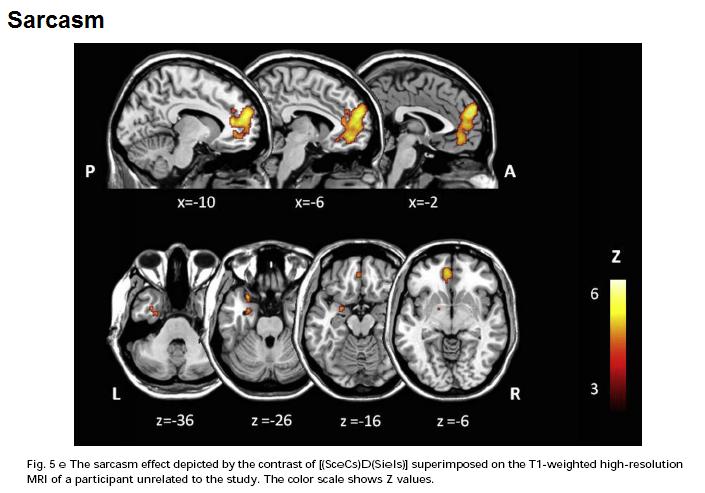
Sarcasm however activated the same mPFC region, but not the caudate:

Sarcasm also activated the amygdala.

*

So what? This is a very nice fMRI study. 20 people is a lot, the task was well-designed and the overlap of the mPFC blobs in the sarcasm-vs-control and the metaphor-vs-control tasks was impressive. There's clearly something going on there in both cases, relative to just reading literal statements. Something's going on in the caudate and thalamus with metaphor but not sarcasm, too.

But what can this kind of study tell us about the brain? They've localized something-about-metaphor to the caudate nucleus, but what is it, and what does the caudate actually do to make that thing happen?

The authors offer a suggestion - the caudate is involved in "searching for the meaning" of the metaphorical statement in order to link it to the context, and work out what the metaphor is getting at. This isn't required for sarcasm because there's only one, literal, meaning - it's just reversed, the speaker actually thinks the exact opposite. Whereas with both sarcasm and metaphor you need to attribute intentions (mentalizing or "Theory of Mind").

That's as plausible an account as any but the problem is that we have no way of knowing, at least not from imaging studies, if it's true or not. As I said this is not the fault of this study but rather an inherent challenge for the whole enterprise. The problem is - switch on your caudate, metaphor coming up - a lot like the challenge facing biology in the aftermath of the Human Genome Project.

The HGP mapped the human genome, and like any map it told us where stuff is, in this case where genes are on chromosomes. You can browse it here. But by itself this didn't tell us anything about biology. We still have to work out what most of these genes actually do; and then we have to work out how they interact; and they we have to work out how those interactions interact with other genes and the environment...

Genomics people call this, broadly speaking, "annotating" the genome, although this is not perhaps an ideal term because it's not merely scribbling notes in the margins, it's the key to understanding. Without annotation, the genome's just a big list.

fMRI is building up a kind of human localization map, a blobome if you will, but by itself this doesn't really tell us much; other tools are required.

ResearchBlogging.orgUchiyama HT, Saito DN, Tanabe HC, Harada T, Seki A, Ohno K, Koeda T, & Sadato N (2011). Distinction between the literal and intended meanings of sentences: A functional magnetic resonance imaging study of metaphor and sarcasm. Cortex; a journal devoted to the study of the nervous system and behavior PMID: 21333979

The Web of Morgellons

A fascinating new paper: Morgellons Disease, or Antipsychotic-Responsive Delusional Parasitosis, in an HIV Patient: Beliefs in The Age of the Internet

“Mr. A” was a 43-year-old man...His most pressing medical complaint was worrisome fatigue. He was not depressed...had no formal psychiatric history, no family psychiatric history, and he was a successful businessman.

He was referred to the psychiatry department by his primary-care physician (PCP) because of a 2-year-long complaint of pruritus [itching] accompanied by the belief of being infested with parasites. Numerous visits to the infectious disease clinic and an extensive medical work-up...had not uncovered any medical disorder, to the patient’s great frustration.

Although no parasites were ever trapped, Mr. A caused skin damage by probing for them and by applying topical solutions such as hydrogen peroxide to “bring them to the surface.” After reading about Morgellons disease on the Internet, he “recalled” extruding particles from his skin, including “dirt” and “fuzz.”

During the initial consultation visit with the psychiatrist, Mr. A was apprehensive but cautiously optimistic that a medication could help. The psychiatrist had been forewarned by the PCP that the patient had discovered a website describing Morgellons and “latched onto” this diagnosis.

However, it was notable that the patient allowed the possibility (“30%”) that he was suffering from delusions (and not Morgellons), mostly because he trusted his PCP, “who has taken very good care of me for many years.”

The patient agreed to a risperidone [an antipsychotic] trial of up to 2 mg per day. [i.e. a lowish dose]. Within weeks, his preoccupation with being infested lessened significantly... Although not 100% convinced that he might not have Morgellons disease, he is no longer pruritic and is no longer damaging his skin or trying to trap insects. He remains greatly improved 1 year later.
(Mr A. had also been HIV+ for 20 years, but he still had good immune function and the HIV may have had nothing to do with the case.)

"Morgellons" is, according to people who say they suffer from it, a mysterious disease characterised by the feeling of parasites or insects moving underneath the skin, accompanied by skin lesions out of which emerge strange, brightly-coloured fibres or threads. Other symptoms include fatigue, aches and pains, and difficulty concentrating.

According to almost all doctors, there are no parasites, the lesions are caused by the patient's own scratching or attempts to dig out the non-existent critters, and the fibres come from clothes, carpets, or other textiles which the patient has somehow inserted into their own skin. It may seem unbelievable that someone could do this "unconsciously", but stranger things have happened.

As the authors of this paper, Freudenreich et al, say, Morgellons is a disease of the internet age. It was "discovered" in 2002 by a Mary Leitao, with Patient Zero being her own 2 year old son. Since then its fame, and the reported number of cases, has grown steadily - especially in California.

Delusional parasitosis is the opposite of Morgellons: doctors believe in it, but the people who have it, don't. It's seen in some mental disorders and is also quite common in abusers of certain drugs like methamphetamine. It feels like there are bugs beneath your skin. There aren't, but the belief that there are is very powerful.

This then is the raw material in most cases; what the concept of "Morgellons" adds is a theory, a social context and a set of expectations that helps make sense of the otherwise baffling symptoms. And as we know expectations, whether positive or negative, tend to be become experiences. The diagnosis doesn't create the symptoms out of nowhere but rather takes them and reshapes them into a coherent pattern.

As Freudenreich et al note, doctors may be tempted to argue with the patient - you don't have Morgellons, there's no such thing, it's absurd - but the whole point is that mainstream medicine couldn't explain the symptoms, which is why the patient turned to less orthodox ideas.

Remember the extensive tests that came up negative "to the patient’s great frustration." And remember that "delusional parasitosis" is not an explanation, just a description, of the symptoms. To diagnose someone with that is saying "We've no idea why but you've imagined this". True, maybe, but not very palatable.

Rather, they say, doctors should just suggest that maybe there's something else going on, and should prescribe a treatment on that basis. Not rejecting the patient's beliefs but saying, maybe you're right, but in my experience this treatment makes people with your condition feel better, and that's why you're here, right?

Whether the pills worked purely as a placebo or whether there was a direct pharmacological effect, we'll never know. Probably it was a bit of both. It's not clear that it's important, really. The patient improved, and it's unlikely that it would have worked as well if they'd been given in a negative atmosphere of coercion or rejection - if indeed he'd agreed to take them at all.

Morgellons is a classic case of a disease that consists of an underlying experience filtered through the lens of a socially-transmitted interpretation. But every disease is that, to a degree. Even the most rigorously "medical" conditions like cancer also come with a set of expectations and a social meaning; psychiatric disorders certainly do.

I guess Morgellons is too new to be a textbook case yet - but it should be. Everyone with an interest in the mind, everyone who treats diseases, and everyone who's ever been ill - everyone really - ought to be familiar with it because while it's an extreme case, it's not unique. "All life is here" in those tangled little fibres.

ResearchBlogging.orgFreudenreich O, Kontos N, Tranulis C, & Cather C (2010). Morgellons disease, or antipsychotic-responsive delusional parasitosis, in an hiv patient: beliefs in the age of the internet. Psychosomatics, 51 (6), 453-7 PMID: 21051675

The Mystery of Stiff Person Syndrome

"Stiff Person Syndrome" (SPS) is a rare neurological disease with a silly name but serious symptoms.

Not in fact a disorder caused by an overdose of Viagra, the defining feature of SPS is uncontrollable muscle rigidity, which comes and goes in bouts, but generally gets worse over time. However, other symptoms are seen including depression, anxiety, and other neurological features such as cerebellar ataxia.

What causes SPS? Well, it's been known for over 20 years that most SPS patients have antibodies against the enzyme GAD65, which is required for the production of GABA, the main inhibitory neurotransmitter in the brain. The body shouldn't be producing antibodies against its own proteins, but unfortunately this does happen quite often, for various reasons, and the result is autoimmune diseases.

So this all seems to make sense. We know that GABA causes muscle relaxation by reducing the brain's input to the muscles. This is why GABA drugs like Valium are muscle-relaxants, and it's part of the reason why drunk people tend to stagger around.

This also explains the anxiety symptoms, because Valium and beer make you less anxious, while drugs that block GABA cause panic attacks. Anti-GAD65 antibodies block GAD, so less GABA gets made. So SPS is autoimmunity against GAD65. Mystery solved?

Not quite. Anti-GAD65 antibodies are also seen in most people with Type I diabetes, but the vast majority of diabetics luckily don't suffer SPS. Mystery remains.

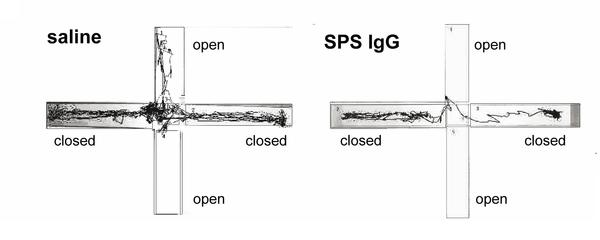
Two studies just out investigated exactly what the antibodies produced by SPS patients do. Geis et al purified the antibodies from a 53 year old woman with SPS and serious anxiety, and injected them into the brains of some rats.

The rats became very anxious. Here's what the cowardly critters did in a standard rodent anxiety test: they avoided the open spaces, which are naturally scary to rodents, who prefer dark, enclosed places:

This was associated with reduced GABA production.

Meanwhile Manto et al found that anti-GAD65 antibodies from another patient with SPS caused very different effects in rat brains compared to the antibodies derived from a patient with autoimmune cerebellar ataxia, but no SPS symptoms. They also found that two kinds of off-the-shelf anti-GAD65 antibodies commonly used in research had different effects as well.

Taken together this all suggests that SPS is caused by anti-GAD65 antibodies, but they have to be a particular type. Different antibodies cause different symptoms even though they all bind to GAD65.

Presumably this is because it's a big protein, and antibodies could bind to any part of it. Only ones that block the "business end" - the part which actually catalyzes the formation of GABA - will cause problems. A bit like how if you get shot in the heart, that's the end of you, but get shot in the foot and it probably won't be.


ResearchBlogging.orgGeis, C., et al. (2011). Human Stiff-Person Syndrome IgG Induces Anxious Behavior in Rats PLoS ONE, 6 (2) DOI: 10.1371/journal.pone.0016775

Manto MU, Hampe CS, Rogemond V, & Honnorat J (2011). Respective implications of glutamate decarboxylase antibodies in stiff person syndrome and cerebellar ataxia. Orphanet journal of rare diseases, 6 (1) PMID: 21294897

Antidepressants Don't Work...In Fish

Here at Neuroskeptic fMRI scanning and antidepressants are both big topics.


As I discussed lask week, fish - specifically salmon - are the next big thing in fMRI and the number of salmon brains being scanned is growing at a remarkable rate. But fish haven't made much of an entrance into the world of antidepressants...until now.

Swedish scientists Holmberg et al have just published a paper asking: Does waterborne citalopram affect the aggressive and sexual behaviour of rainbow trout and guppy?

SSRI antidepressants, of which citalopram is one, are very popular. So popular, in fact, that non-trivial levels of SSRIs have been found in sewage and there's a concern that they might make their way into lakes and rivers and thereby affect the behaviour of the animals living there.

Holmberg et al set out to see what citalopram did to some fish in an attempt to find out whether this is likely to be a major problem. So they put some citalopram in the fish's water supplies and then tested their aggressiveness and also their sex drives. It turns out that one of the main ways of measure fish aggression is to put a mirror in their tank and see if they try to fight their own reflection. Fish are not very bright, really.

Anyway, the good news for fish everywhere was that seven days of citalopram exposure had no effect at all, even at doses much higher than those reported as a pollutant (the maximum dose was 0.1 mg/l). And the authors had no conflicts of interest: Big Pharma had nothing to do with this research, although Big Fish Farmer did because they bought the fish from one.

However, this may not be the end of the story, because it turned out that citalopram was very poorly absorbed into the fish's bloodstreams. But other antidepressants have been reported to accumulate in fish. Clearly, the only way to find out for sure what's going on would be to use fMRI...

ResearchBlogging.orgHolmberg A, Fogel J, Albertsson E, Fick J, Brown JN, Paxéus N, Förlin L, Johnsson JI, & Larsson DG (2011). Does waterborne citalopram affect the aggressive and sexual behaviour of rainbow trout and guppy? Journal of hazardous materials PMID: 21300431

The Social Network and Anorexia

Could social networks be more important than the media in the spread of eating disorders?

There's a story about eating disorders roughly like this: eating disorders (ED) are about wanting to be thin. The idea that thinness is desireable is something that's spread by Western media, especially visual media i.e. TV and magazines. Therefore, Western media exposure causes eating disorders.

It's a nice simple theory. And it seems to fit with the fact that eating disorders, hitherto very rare, start to appear in a certain country in conjunction with the spread of Westernized media. A number of studies have shown this. However, a new paper suggests that there may be rather more to it: Social network media exposure and adolescent eating pathology in Fiji.

Fiji is a former British colony, a tropical island nation of less than a million. Just over half the population are ethnic native Fijian people. Until recently, these Fijians were relatively untouched by Western culture, but this is starting to change.

The authors of this study surveyed 523 Fijian high school girls. Interviews took place in 2007. They asked them various questions relating to, one the one hand, eating disorder symptoms, and on the other hand, their exposure to various forms of media.

They looked at both individual exposure - hours of TV watched, electronic entertainment in the home - and "indirect" or "social network" exposure, such as TV watched by the parents, and the amount of electronic entertainment their friends owned. On top of this they measured Westernization/"globalization", such as the amount of overseas travel by the girls or their parents.

So what happened? Basically, social network media exposure, urbanization, and Westernization correlated with ED symptoms, but when you controlled for those variables, personal media exposure didn't correlate. Here's the data; the column I've highlighted is the data where each variable is controlled for the others. The correlations are pretty small (0 is none, 1.0 would be perfect) but significant.


They conclude that:

Although consistent with the prevailing sociocultural model for the relation between media exposure and disordered eating... our finding, that indirect exposure to media content may be even more influential than direct exposure in this particular social context, is novel.
The idea that eating disorders are simply a product of a culture which values thinness as attractive has always seemed a bit shaky to me because people with anorexia frequently starve themselves far past the point of being attractive even by the unrealistic standards of magazines and movies.

In fact, if eating disorders were just an attempt to "look good", they wouldn't be nearly so dangerous as they are, because no matter how thin-obsessed our culture may be, no-one thinks this is attractive, or normal, or sane. But this, or worse, is what a lot of anorexics end up as.

On the other hand, eating disorders are associated with modern Western culture. There must be a link, but maybe it's more complicated than just "thin = good" causes anorexia. What if you also need the idea of "eating disorders"?

This was the argument put forward by Ethan Watters in Crazy Like Us (my review)... in his account of the rise of anorexia in Hong Kong. Essentially, he said, anorexia was vanishingly rare in Hong Kong until after the much-publicized death of a 14 year old girl, Charlene Chi-Ying, in the street. As he put it:
In trying to explain what happened to Charlene, local reporters often simply copied out of American diagnostic manuals. The mental-health experts quoted in the Hong Kong papers and magazines confidently reported that anorexia in Hong Kong was the same disorder that appeared in the United States and Europe...

As the general public and the region's mental-health professionals came to understand the American diagnosis of anorexia, the presentation of the illness in [Hong Kong psychiatrist] Lee's patient population appeared to transform into the more virulent American standard. Lee once saw two or three anorexic patients a year; by the end of the 1990s he was seeing that many new cases each month.
Now it's important not to see this as trivializing the condition or as a way of blaming the victim; "they're just following a trend!". You only have to look at someone with anorexia to see that there is nothing trivial about it. However, that doesn't mean it's not a social phenomenon.

It's a long way from the data in this study to Watters' conclusions, but maybe not an impossible leap. Part of Westernization, after all, is exposure to Western ideas about what is healthy eating and what's an eating disorder...

ResearchBlogging.orgBecker, A., Fay, K., Agnew-Blais, J., Khan, A., Striegel-Moore, R., & Gilman, S. (2011). Social network media exposure and adolescent eating pathology in Fiji The British Journal of Psychiatry, 198 (1), 43-50 DOI: 10.1192/bjp.bp.110.078675

 
powered by Blogger