Tampilkan postingan dengan label 1in4. Tampilkan semua postingan

BBC: Something Happened, For Some Reason

According to the BBC, the British recession and spending cuts are making us all depressed.


They found that between 2006 and 2010, prescriptions for SSRI antidepressants rose by 43%. They attribute this to a rise in the rates of depression caused by the financial crisis. OK there are a few caveats, but this is the clear message of an article titled Money woes 'linked to rise in depression'. To get this data they used the Freedom of Information Act.

What they don't do is to provide any of the raw data. So we just have to take their word for it. Maybe someone ought to use the Freedom of Information Act to make them tell us? This is important, because while I'll take the BBC's word about the SSRI rise of 43%, they also say that rates of other antidepressants rose - but they don't say which ones, by how much, or anything else. They don't say how many fell, or stayed flat.

Given which it's impossible to know what to make of this. Here are some alternative explanations:

  • This just represents the continuation of the well-known trend, seen in the USA and Europe as well as the UK, for increasing antidepressant use. This is my personal best guess and Ben Goldacre points out that rates rose 36% during the boom years of 2000-2005.
  • Depression has not got more common, it's just that it's more likely to be treated. This overlaps with the first theory. Support for this comes from the fact that suicide rates haven't risen - at least not by anywhere near 40%.
  • Mental illness is no more likely to be treated, but it's more likely to be treated with antidepressants, as opposed to other drugs. There was, and is, a move to get people off drugs like benzodiazepines, and onto antidepressants. However I suspect this process is largely complete now.
  • Total antidepressant use isn't rising but SSRI use is because doctors increasingly prescribe SSRIs over opposed to other drugs. This was another Ben Goldacre suggestion and it is surely a factor although again, I suspect that this process was largely complete by 2007.
  • People are more likely to be taking multiple different antidepressants, which would manifest as a rise in prescriptions, even if the total number of users stayed constant. Add-on treatment with mirtazapine and others is becoming more popular.
  • People are staying on antidepressants for longer meaning more prescriptions. This might not even mean that they're staying ill for longer, it might just mean that doctors are getting better at convincing people to keep taking them by e.g. prescribing drugs with milder side effects, or by referring people for psychotherapy which could increase use by keeping people "in the system" and taking their medication. This is very likely. I previously blogged about a paper showing that in 1993 to 2005, antidepressant prescriptions rose although rates of depression fell, because of a small rise in the number of people taking them for very long periods.
  • Mental illness rates are rising, but it's not depression: it's anxiety, or something else. Entirely plausible since we know that many people taking antidepressants, in the USA, have no diagnosable depression and even no diagnosable psychiatric disorder at all.
  • People are relying on the NHS to prescribe them drugs, as opposed to private doctors, because they can't afford to go private. Private medicine in the UK is only a small sector so this is unlikely to account for much but it's the kind of thing you need to think about.
  • Rates of depression have risen, but it's nothing to do with the economy, it's something else which happened between 2007 and 2010: the Premiership of Gordon Brown? The assassination of Benazir Bhutto? The discovery of a 2,100 year old Japanese melon?
Personally, my money's on the melon.

Depressed or Bereaved? (Part 2)

In Part 1, I discussed a paper by Jerome Wakefield examining the issue of where to draw the line between normal grief and clinical depression.


The line moved in the American Psychiatric Association's DSM diagnostic system when the previous DSM-III edition was replaced by the current DSM-IV. Specifically, the "bereavement exclusion" was made narrower.

The bereavement exclusion says that you shouldn't diagnose depression in someone whose "depressive" symptoms are a result of grief - unless they're particularly severe or prolonged when you should. DSM-IV lowered the bar for "severe" and "prolonged", thus making grief more likely to be classed as depression. Wakefield argued that the change made things worse.

But DSM-V is on its way soon. The draft was put up online in 2010, and it turns out that depression is to have no bereavement exclusion at all. Grief can be diagnosed as depression in exactly the same way as depressive symptoms which come out of the blue.

The draft itself offered just one sentence by way of justification for this. However, big cheese psychiatrist Kenneth S. Kendler recently posted a brief note defending the decision. Wakefield has just published a rather longer paper in response.

Wakefield starts off with a bit of scholarly kung-fu. Kendler says that the precursors to the modern DSM, the 1972 Feighner and 1975 RDC criteria, didn't have a bereavement clause for depression either. But they did - albeit not in the criteria themselves, but in the accompanying how-to manuals; the criteria themselves weren't meant to be self-contained, unlike the DSM. Ouch! And so on.

Kendler's sole substantive argument against the exclusion is that it is "not logically defensible" to exclude depression induced by bereavement, if we don't have a similar provision for depression following other severe loss or traumatic events, like becoming unemployed or being diagnosed with cancer.

Wakefield responds that, yes, he has long made exactly that point, and that in his view we should take the context into account, rather than just looking at the symptoms, in grief and many other cases. However, as he points out, it is better to do this for one class of events (bereavement), than for none at all. He quotes Emerson's famous warning that "A foolish consistency is the hobgoblin of little minds". It's better to be partly right, than consistently wrong.

Personally, I'm sympathetic to Wakefield's argument that the bereavement exclusion should be extended to cover non-bereavement events, but I'm also concerned that this could lead to underdiagnosis if it relied too much on self-report.

The problem is that depression usually feels like it's been caused by something that's happened, but this doesn't mean it was; one of the most insidious features of depression is that it makes things seem much worse than they actually are, so it seems like the depression is an appropriate reaction to real difficulties, when to anyone else, or to yourself looking back on it after recovery, it was completely out of proportion. So it's a tricky one.

Anyway, back to bereavement; Kendler curiously ends up by agreeing that there ought to be a bereavement clause - in practice. He says that just because someone meets criteria for depression does not mean we have to treat them:

...diagnosis in psychiatry as in the rest of medicine provides the possibility but by no means the requirement that treatment be initiated ... a good psychiatrist, on seeing an individual with major depression after bereavement, would start with a diagnostic evaluation.

If the criteria for major depression are met, then he or she would then have the opportunity to assess whether a conservative watch and wait approach is indicated or whether, because of suicidal ideation, major role impairment or a substantial clinical worsening the benefits of treatment outweigh the limitations.
The final sentence is lifted almost word for word from the current bereavement clause, so this seems to be an admission that the exclusion is, after all, valid, as part of the clinical decision-making process, rather than the diagnostic system.

OK, but as Wakefield points out, why misdiagnose people if you can help it? It seems to be tempting fate. Kendler says that a "good psychiatrist" wouldn't treat normal, uncomplicated bereavement as depression. But what about the bad ones? Why on earth would you deliberately make your system such that good psychiatrists would ignore it?

More importantly, scrapping the bereavement criterion would render the whole concept of Major Depression meaningless. Almost everyone suffers grief at some point in their lives. Already, 40% of people meet criteria for depression by age 32, and that's with a bereavement exclusion.

Scrap it and, I don't know, 80% will meet criteria by that age - so the criteria will be useless as a guide to identifying the people who actually have depression as opposed to the ones who have just suffered grief. We're already not far off that point, but this would really take the biscuit.

ResearchBlogging.orgWakefield JC (2011) Should Uncomplicated Bereavement-Related Depression Be Reclassified as a Disorder in the DSM-5? The Journal of nervous and mental disease, 199 (3), 203-8 PMID: 21346493

Depressed Or Bereaved? (Part 1)

Part 2 is now out here.

My cat died on Tuesday. She may have been a manipulative psychopath, but she was a likeable one. She was 18.On that note, here's a paper about bereavement.

It's been recognized since forever that clinical depression is similar, in many ways, to the experience of grief. Freud wrote about it in 1917, and it was an ancient idea even then. So psychiatrists have long thought that symptoms, which would indicate depression in someone who wasn't bereaved, can be quite normal and healthy as a response to the loss of a loved one. You can't go around diagnosing depression purely on the basis of the symptoms, out of context.

On the other hand, sometimes grief does become pathological - it triggers depression. So equally, you can't just decide to never diagnose depression in the bereaved. How do you tell the difference between "normal" and "complicated" grief, though? This is where opinions differ.

Jerome Wakefield (of Loss of Sadness fame) and colleagues compared two methods. They looked at the NCS survey of the American population, and took everyone who'd suffered a possible depressive episode following bereavement. There were 156 of these.

They then divided these cases into "complicated" grief (depression) vs "uncomplicated" grief, first using the older DSM-III-R criteria, and then with the current DSM-IV ones. Both have a bereavement exclusion for the depression criteria - don't diagnose depression if it's bereavement - but they also have criteria for complicated grief which is depression, exclusions to the exclusion.

The systems differ in two major ways: the older criteria were ambiguous but at the time, they were generally interpreted to mean that you needed to have two features out of a possible five; prolonged duration was one of the list and anything over 12 months was considered "prolonged". In DSM-IV, however, you only need one criterion, and anything over 2 months is prolonged.

What happened? DSM-IV classified many more cases as complicated than the older criteria - 80% vs 45%. That's no surprise there because the criteria are obviously a lot broader. But which was better? In order to evaluate them, they compared the "complicated" vs "normal" episodes on six hallmarks of clinical depression - melancholic features, seeking medical treatment, etc.

They found that "complicated" cases were more severe under both criteria but the difference was much more clear cut using DSM-III-R.

Wakefield et al are not saying that the DSM-III-R criteria were perfect. However, it was better at identifying the severe cases than the DSM-IV, which is worrying because DSM-IV was meant to be an improvement on the old system.

Hang on though. DSM-V is coming soon. Are they planning to put things back to how they were, or invent an even better system? No. They're planning to, er, get rid of the bereavement criteria altogether and treat bereavement just like non-bereavement. Seriously. In other words they are planning to diagnose depression purely on the basis of the symptoms, out of context.

Which is so crazy that Wakefield has written another paper all about it (he's been busy recently), which I'm going to cover in an upcoming post. So stay tuned.

ResearchBlogging.orgWakefield JC, Schmitz MF, & Baer JC (2011). Did narrowing the major depression bereavement exclusion from DSM-III-R to DSM-IV increase validity? The Journal of nervous and mental disease, 199 (2), 66-73 PMID: 21278534

Antidepressants Still Don't Work In Mild Depression

A new paper has added to the growing ranks of studies finding that antidepressant drugs don't work in people with milder forms of depression: Efficacy of antidepressants and benzodiazepines in minor depression.


It's in the British Journal of Psychiatry and it's a meta-analysis of 6 randomized controlled trials on three different drugs. Antidepressants were no better than placebo in patients with "minor depressive disorder", which is like the better-known Major Depressive Disorder but... well, not as major, because you only need to have 2 symptoms instead of 5 from this list.

They also wanted to find out whether benzodiazepines (like Valium) worked in these people, but there just weren't any good studies out there.

The results look solid, and they fit with the fact that antidepressants don't work in people diagnosed with "major" depression, but who fall at the "milder" end of that range, something which several recent studies have shown. Neuroskeptic readers will, if they've been paying attention, find this entirely unsurprising.

But in fact, it's not just not news, it's positively ancient. 50 years ago, at the dawn of the antidepressant era, it was commonly said that most antidepressants don't work in everyone with "depression", they work best in people with endogenous depression, and less well, or not at all, in those with "neurotic" or "reactive" depressions (see, e.g. 1, 2, 3, but the literature goes back even further).

"Endogenous" is not strictly the same as "severe", however, in practice, these two concepts have never really been clearly seperated, and they're largely equivalent today, because the leading measure of "severity", the Hamilton Scale, measures symptoms, and arguably these symptoms are mostly (though not entirely) the symptoms of the old concept of endogenous depression. The Hamilton Scale was formulated in 1960 when modern concepts of "minor depressive disorder" and "major depressive disorder" were unknown.

Why then are we only now working out that antidepressants only work in some people? There's one obvious answer: Prozac, which arrived in 1987. Before Prozac, antidepressants were serious stuff. They could easily kill you in overdose, and they had a lot of side effects. Many of them even meant that you couldn't eat cheese. As a result, they weren't used lightly.

Prozac and the other SSRIs changed the game completely. They're much less toxic, the side effects are milder, and you can eat as much cheese as you want. So it's very easy to prescribe an SSRI - maybe it won't work, but it can't hurt, so why not try it...?

As a result, I think, the concept of "depression" broadened. Before Prozac, depression was inherently serious, because the treatments were serious. After Prozac, it didn't have to be. Drug company marketing no doubt helped this process along, but marketing has to have something to work with. Over the past 25 years, terms like "endogenous", "neurotic" etc. largely disappeared from the literature, replaced by the single construct of "Major Depression".

For nearly 1,000 years, the great scientific and philosophical work of the ancient Greeks and Romans were lost to Europeans. Only when Christian scholars rediscovered them in the libraries of the Islamic world did Europe begin to remember what it had forgotten. We call those the Dark Ages. Will the past 25 years be remembered as psychiatry's Dark Age?

ResearchBlogging.orgBarbui, C., Cipriani, A., Patel, V., Ayuso-Mateos, J., & van Ommeren, M. (2011). Efficacy of antidepressants and benzodiazepines in minor depression: systematic review and meta-analysis The British Journal of Psychiatry, 198 (1), 11-16 DOI: 10.1192/bjp.bp.109.076448

Depression Treatment Increased From 1998 to 2007

A paper just out reports on the changing patterns of treatment for depression in the USA, over the period from 1998 to 2007.

The headline news is that it increased: the overall rate of people treated for some form of "depression" went from 2.37% to 2.88% per year. That's an increase of 21%, which is not trivial, but it's much less than the increase in the previous decade: it was just 0.73% in 1987.

But the increase was concentrated in. some groups of people.

  • Americans over 50 accounted for the bulk of the rise. Their use went up by about 50%, while rates in younger people stayed almost steady. In '98 the peak age band was 35-49, now it's 50-64, with almost 5% of those people getting treated in any given year.
  • Men's rates of treatment went up by over 40% while women's only increased by 10%. Women are still more likely to get treated for depression than men, though, with a ratio of 1.7 women for each 1 man. But that ratio is a lot closer than it used to be.
  • Black people's rates increased hugely, by 120%. Rates in black people now stand at 2.2% which is close behind whites at 3.2%. Hispanics are now the least treated major ethnic group at 1.9%: in previous studies, blacks were the least treated. (There was no data on Asians or others).
So the increase wasn't an across the board rise, as we saw from '87 to '98. Rather the '98-'07 increase was more of a "catching up" by people who've historically had low levels of treatment, closing in on the level of the historically highest group: middle-aged white women.

In terms of what treatments people got, out of everyone treated for depression, 80% got some kind of drugs, and that didn't change much. But use of psychotherapy declined a bit from 54% to 43% (some people got both).

What's also interesting is that the same authors reported last year that, over pretty much the same time period ('96 to '05), the number of Americans who used antidepressants in any given year sky-rocketed from 5% to 10% - that is to say, much faster than the rate of depression treatment rose! And the data are comparable, because they came from the same national MEPS surveys.

In other words, the decade must have seen antidepressants increasingly being used to treat stuff other than depression. What stuff? Well, all kinds of things. SSRIs are popular in everything from anxiety and OCD to premature ejaculation. Several of the "other new" drugs, like mirtazapine and trazodone, are very good at putting you to sleep (rather too good, some users would say...)

ResearchBlogging.orgMarcus SC, & Olfson M (2010). National trends in the treatment for depression from 1998 to 2007. Archives of general psychiatry, 67 (12), 1265-73 PMID: 21135326

Normal? You're Weird - Psychiatrists

Almost everyone is pretty screwed up. That's not my opinion, that's official - according to a new paper in the latest British Journal of Psychiatry.

Make sure you're sitting down for this. No less than 48% of the population have "personality difficulties", and on top of that 21% have a full blown "personality disorder", and another 7% have it even worse with "complex" or "severe" personality disorders.

That's quite a lot of people. Indeed it only leaves an elite 22.5% with no personality disturbances whatsoever. You're as likely to have a "simple PD" as you are to have a normal personality, and fully half the population fall into the "difficulties" category.

I have difficulties with this.

Where do these results come from? The Adult Psychiatric Morbidity Survey, which is a government study of the British population. They phoned up a random sample of several thousand people, and gave them the SCID interview, in other words they asked them questions. 116 questions in fact.

48% of people answered "yes" to enough questions such that, according to their criteria, they had "personality difficulties". They defined "personality difficulties", which is not a term in common use, as being "one criterion less than the threshold for personality disorder (PD)" according to DSM-IV criteria.

So what? Well, as far as I'm concerned, that means simply that "personality difficulties" is a crap category, which labels normality as pathological. I can tell that most of people with "difficulties" are in fact normal because they are the literally the norm. It's not rocket science.

So we can conclude that "personality difficulties" should either be scrapped or renamed "normal". In which case the weird minority of people without any such features should be relabelled. Maybe they are best known as "saints", or "Übermenschen", or perhaps "people who lie on questionnaires".

This, however, is not what the authors say. They defend their category of Personality Difficulties on the grounds that this group are slightly more likely to have a history of "issues" than the elite 22.5 percent, e.g. homelessness (3.0% vs. 1.6%), 'financial crisis' (10.1% vs. 6.8%), or having had treatment for mental illness (11% vs 6%).

They say:

The finding that 72% of the population has at least some degree of personality disturbance is counterintuitive, but the evidence that those with ‘personality difficulty’ covering two out of five of the population [it's actually closer to half], differs significantly from those with no personality disturbance in the prevalence of a history of running away from home, police contacts, homelessness... shows that this separation is useful from both clinical and societal viewpoints.
Well, yeah...but no. The vast majority (90+%) of people with Personality Difficulty had no history of these things. It's true that, as a group, they have higher average rates, but all this tells you is that some of them have problems. I suspect they're the ones right at the "top end" of this category, the people who are almost into the next category up.

Here's what I think is going on:

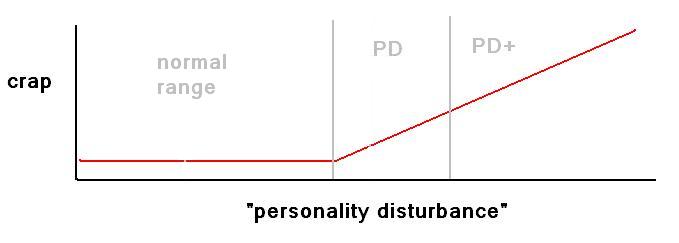
The "difficulties" group and the "none" group are essentially the same in terms of the levels of crap stuff happening to them - because they are the same, normal, everyday people - except that a small % of the "difficulties" group do have some moderate degree of problems, because they are close to being "PD".

This does not mean that the "difficulties" category is good. Quite the reverse, it means it's rubbish, because it spans so many diverse people and lumps them all together. What you should do, if you insist on drawing lines in the sand, would be this:

Now I don't know that that's how things work, but it seems plausible. Bearing in mind that the categories they used are entirely arbitrary, it would be very odd if they did correspond to reality.

To be fair to the authors, this is not the only argument in their paper. Their basic point is that personality disturbance is a spectrum: rather than it being a black-and-white question of "normal" vs."PD", there are degrees, ranging from "simple PD" which is associated with a moderate degree of life crap, up to "complex PD" which has much more and "severe PD" which is worst of all.

They suggest that in the upcoming DSM-V revision of psychiatric diagnosis, it would be useful to formally incorporate the severity spectrum in some way - unlike the current DSM-IV, there everything is either/or. They also argue that with more severe cases of PD, it is not very useful to assign individual PD diagnoses (DSM-IV has no less than 10 different PDs) - severe PD is just severe PD.

That's all fine, as long as it doesn't lead to pathologizing 78% of the population - but this is exactly what it might do. The authors do admit that "the SCID screen for personality disorder, like almost all screening instruments, overdiagnoses personality pathology", but provide little assurance that a "spectrum" approach won't do the same thing.

ResearchBlogging.orgYang M, Coid J, & Tyrer P (2010). Personality pathology recorded by severity: national survey. The British Journal of Psychiatry 197, 193-9 PMID: 20807963

Commercialization vs. Medicalization

Suppose there was someone who's perfectly healthy, just stressed, or worried, or or unhappy.

And suppose that, for whatever reason, they go see their doctor about their problems, they get a diagnosis of depression, or social anxiety disorder, or something, and a prescription for Prozac.

What's wrong with this picture? Well, it's a clear case of medicalization: because I made it up to be a good example of medicalization. But what's wrong with medicalization? The medicines themselves? Many people think so, but if you ask me, they're the least troublesome part of the process.

*

Drugs cost money, but not much: generic fluoxetine, i.e. non-brand-name Prozac, currently costs less than 10 cents per day. Drugs have side effects, but if our hypothetical person doesn't like the Prozac he or she's been prescribed, there's nothing stopping them from chucking it in the bin.

A diagnosis, on the other hand, is a lot harder to shake. In theory, one could get a second opinion from a different doctor and be declared perfectly healthy but in all my conversations with psychiatrists and patients I've never known of someone with a mental health diagnosis getting "undiagnosed" completely.

What's harmful about a mental health diagnosis? It changes the way you think about yourself, in many complicated ways. Just for one thing, it's likely to make you reconsider your past actions and ask if they were "really you", or whether they were caused by your illness.

Now, if you really are mentally ill, that is, if the diagnosis is accurate, this change will probably be a good thing; it might help you realize that with help, you can change, and avoid making the same mistakes you blame yourself for, for example. But if you're not ill, the same changes might be harmful.

A diagnosis invites you to think about problems through the lens of objective, impersonal analysis and treatment, what we might call the "clinical approach". The clinical approach is obviously the best one for most physical diseases. If you have cholera, you are ill, and you need to be diagnosed, and treated appropriately. Most people would agree that the clinical approach is also useful, albeit more problematic, in clear cut mental illnesses like schizophrenia, bipolar disorder, and (some cases of) depression.

But if your problem, or the root of your problems, is not that you're ill but that you're poor, or a victim of discrimination, or in the wrong job, or the wrong relationship, or you don't have either, etc. then a diagnosis is both futile, and quite possibly, actively harmful.

Futile because there's no disease to treat, and harmful because by situating that the origins of your problems are inside yourself (your neurochemistry, a "chemical imbalance"), it diverts attention from the real issues and the real solutions. Maybe you just need to change your situation, take a decision, get a new perspective, stop doing something.

*

Is there an answer? Many people want us to stop taking so many antidepressants: reverse the trend of medicalization, by reducing the number of pills we take. But there may be another way: commercialization.

Suppose that you didn't need a prescription to get Prozac: you just bought SSRIs over the counter, like aspirin, whenever you felt like it. What would this mean? It might mean more people taking Prozac, although I'm not sure it would. But it would almost certainly change the way people think about antidepressants.

Commercializing SSRIs would, I think, mean that many SSRI users stopped seeing themselves as "psychiatric patients", or as the pills as cures for their "illnesses". Instead they'd see them more like aspirin, or coffee, or beer: something to help you "feel better", a nice thing to have in some circumstances, but not something that's going to solve all your problems. It would, in other words, prevent mentally healthy people from thinking of themselves as "mentally ill". With any luck, our hypothetical friend from the first paragraph would be one of them.

Of course, this would be no benefit if you think that the whole problem with Prozac is the actual drug, fluoxetine hydrochloride. But if, like me, you think fluoxetine hydrochloride is pretty benign compared to the idea of Prozac, it would be a good move. The good thing about commercialization is that it makes it easy to buy things without having to think about them.

*

You can easily take this argument too far, and if you do, you'll eventually arrive approximately here. Don't. Serious clinical depression and anxiety disorders are real, and people who suffer from them often need "prescription-strength" drugs, and more importantly, professional help rather than being left to self-treat, because the ability to take care of yourself is, almost by definition, impaired in mental illness.

But these people might benefit from the commercialization of mood as well. They'd no longer be seen as qualitatively different from everyone else, weird and unusual. It's like how if someone's got severe pain, and needs prescription-strength painkillers, that's no big deal, because hey, we've all taken aspirin for headaches.

*

Commercialization would be better than medicalization for other drugs too. Take flibanserin, the new drug for "Hypoactive Sexual Desire Disorder", a condition which, according to the drug company who make flibanserin, affects maybe 20% of women.

Whether flibanserin really boosts libido to any significant extent is unclear, but let's assume it does. Why not sell it over-the-counter? Give it a raunchy name, put it in a colorful box, and sell it in pharmacies next to the condoms. I can picture it now...

Now that would be pretty ridiculous. It would be a crass example of the commercialization of sexuality. But flibanserin already is - or at least, saying 20% of women ought to be taking it is. By selling it as a lifestyle product, instead of a medical treatment, its crassness would be obvious, and we'd just have lots of people taking flibanserin, instead of lots of people taking flibanserin and thinking of themselves as suffering from "Hypoactive Sexual Desire Disorder" i.e. a mental illness.

Unfortunately, I rather doubt that this is going to happen any time soon, although if you go to many "3rd world" countries, you'll find antidepressants, and indeed most other drugs, on the pharmacy shelves for anyone to buy without a prescription. To Westerners, this might seem primitive. I'm not so sure.

Attitudes to Mental Illness

Ever wondered what the British public think about mental illness?

Well, the British government has, and the results of the 2010 Attitudes to Mental Illness Survey are out. I'm never sure how much faith to put in such data because what people are willing to say they think, and what they really feel, are not the same.

So while it's encouraging that only 20% of people say they agree with the statement that "Anyone with a history of mental illness should be excluded from taking public office", it would be naive to think that the other 80% would really be equally likely to vote for someone with a psychiatric history when push came to shove. We've moved on since McGovern, but maybe not all that much.

Worse, a lot of the questions are dubious. One asks whether you agree that "Mental hospitals are an outdated means of treating people with mental illness", the 'right' answer, that gets counted as a nice positive attitude, being to agree. I disagree, not least because inpatient treatment for depression helped my grandfather hugely when he was a young man. If that means I have a bad attitude to the mentally ill, so be it. I don't think it does.

*

Another item asks "What proportion of people in the UK do you think might have a mental health problem at some point in their lives?" The approved answer, as Neuroskeptic readers may have guessed, was 1 in 4. But only 16% of the British public picked that option from the multiple-choice quiz. Most thought it was much lower:

How silly of them...or maybe not. There has in fact never been a study of the lifetime prevalence of mental illness in Britain. Studies in other English-speaking countries, such as the US and New Zealand, have repeatedly shown lifetime prevalence rates of 50%, or higher, for mental illness according to DSM-IV criteria. But these figures and these criteria have been credibly accused of overstating the proportion of people with a genuine psychiatric illness, maybe greatly so. There's a lot to say on both sides of this debate, but the point is that the question is open. Expecting the public to know the answer, when the experts don't, is rather unfair.

However, interestingly enough, this very survey asked whether respondents had ever suffered mental illness themselves. How many had? There's a 4 in it, but it's not 1 in 4, it's 4%.

I strongly suspect this is an underestimate. Some people are ill and don't know it or don't admit it. People with mental illness might be less likely to participate in the study. There'll be people will get ill at some point in their lives after they fill in the survey. And the format of the question was a bit odd (see page 64 and see what you make of it). But still, this is another point of data for the great prevalence debate.

The proportion of people with mental illness ultimately depends on how you define "mental illness". I don't think anyone has an entirely satisfactory definition, so any attempt to pin down the lifetime prevalence is problematic until we sort that out, but if I had to put it a number on it, it would be about 1 in 10 in Western countries.

I'm no expert on this topic so take this with a big pinch of salt. Still, I'd find it very hard to accept a figure much lower than this, from personal experience if nothing else. I'd be open to the idea that the true figure is much higher, but this would mean that tens of millions of British people are going around getting mentally ill and never receiving treatment, and it would take some very strong evidence to convince me of that.

Crazy Like Us

You've probably heard about Crazy Like Us, the new book by Urban Tribes author Ethan Watters. But you probably haven't bought it yet. You really should.

Crazy Like Us is a vivid, humane, and thought-provoking examination of "the globalization of the American psyche" - the process by which, slowly but surely, the world has adopted America's way of thinking about mental illness.

*

The key to the American approach is the 844-page Diagnostic and Statistical Manual of the American Psychiatric Association - the DSM, or as the saying goes, the Bible of psychiatry. The heart of the DSM is a long list of disorders, each with a code number, and each with an accompanying list of symptoms: Major Depressive Disorder (296.2), Post-Traumatic Stress Disorder (309.81), Schizophrenia (295.90), etc. The DSM is more than just a catalogue of names and numbers, however; it's part a conceptual system, a way of deciding what kind of feelings and behaviours are normal, and which are pathological; it's almost a philosophy of life.

On the most straightforward level, Crazy Like Us is the story of how, over the past 20 years, this system has gone from being American to international, displacing the ways of thinking found in other countries and cultures. In four chapters, Watters describes the rise of anorexia in Hong Kong, PTSD in Sri Lanka following the 2004 tsunami, schizophrenia in Madagascar, and major depressive disorder in Japan.

This much is plain fact. The DSM is now the internationally-recognized standard for psychiatric diagnosis; almost all academic papers in psychiatry make use of the American criteria, or the extremely similar ICD-10. What's interesting, however, is Watters' account of how the DSM spread so quickly to other countries, displacing what were - in many cases - equally rich and complex local vocabularies of distress and disorder.

In the case of Japan, Watters' answer is simple: the big drug companies, in the hopes of opening a new market for SSRI antidepressants, promoted the concept of clinical depression as a common ailment, through campaigns in the Japanese media. (Japan did have an "indigenous" concept of depression, utsubyo, but it was seen as a rare, serious disease, like schizophrenia.)

But in "developing" countries, such as Sri Lanka, the picture is rather more complex. Sri Lankans were eager to learn from the West about mental illness because of their respect for Western science and technology. Americans can put people into space - surely, they know a lot about everything, including medicine, including psychiatry.

*

Yet there's another level to the story of Crazy Like Us, a more interesting and more controversial one. Watters' argues that the globalization of the American way of thinking has actually changed the nature of "mental illness" around the world. As he puts it:
In the process of teaching the rest of the world to think like us, we’ve been exporting our Western “symptom repertoire” as well. That is, we’ve been changing not only the treatments but also the expression of mental illness in other cultures.
Essentially, mental illness - or at least, much of it - is a way of unconsciously expressing emotional or social distress and tension. Our culture, which includes of course our psychiatric textbooks, tells us various ways in which distress can manifest, provides us with explanations and narratives to make our distress understandable. And so it happens. The symptoms are not acted or "faked" - they're as real to the sufferer as they are to anyone else. But they are culturally shaped.


The historian of psychiatry, Edward Shorter, has written of how, in late 19th century Europe, people (mostly women) were said to be especially prone to suffering from "hysterical paralysis", but every time and place has its own shared "symptom repertoire". Culture does not just create symptoms out of thin air - there has to be some kind of underlying stress. As Watters puts it
We can become psychologically unhinged for many reasons that are common to all, like personal traumas, social upheavals or biochemical imbalances in our brains. ... Whatever the trigger, however, the ill individual and those around him invariably rely on cultural beliefs and stories to understand what is happening.
Watters links anorexia in 1990s Hong Kong to the anxiety caused by the impending transfer of control from Britain to China, a geopolitical event which caused personal worry and social disruption as people or families emigrated. But it was the high-profile 1994 case of a young girl's death from self-starvation, and the subsequent media attention paid to the Western concept of Anorexia Nervosa (DSM code 307.1), that put self-starvation into the symptom repertoire for distressed young women and led to the rise in cases.

The idea that America has exported not just concepts of illness, but illnesses themselves, is a provocative one. Is it true? Commentators have pointed out that Watters' explanation of the rise of anorexia in Hong Kong is rather simplistic. There were many social and cultural changes going on during the 1990s, most of which had nothing to do with the DSM. How do we know that increasing media promotion of dieting, and the fashion for thinness, wasn't also important? In truth, we don't, but I do not think that Watters' argument requires psychiatry to be the only force at work.

*

Overall, Crazy Like Us is a fascinating book about transcultural psychiatry and medical anthropology. But it's more than that, and it would be a mistake - and deeply ironic - if we were to see it as a book all about foreigners, "them". It's really about us, Americans and by extension Europeans (although there are some interesting transatlantic contrasts in psychiatry, they're relatively minor.)

If our way of thinking about mental illness is as culturally bound as any other, then our own "psychiatric disorders" are no more eternal and objectively real than those Malaysian syndromes like amok, episodes of anger followed by amnesia, or koro, the fear the that ones genitals are shrinking away.

In other words, maybe patients with "anorexia", "PTSD" and perhaps "schizophrenia" don't "really" have those things at all - at least not if these are thought of as objectively-existing diseases. In which case, what do they have? Do they have anything? And what are we doing to them by diagnosing and treating them as if they did?

Watters' does not discuss such questions; I think this was the right choice, because a full exploration of these issues would fill at least one book in itself. But here are a few thoughts:

First, the most damaging thing about the globalization of Western psychiatric concepts is not so much the concepts themselves, but their tendency to displace and dissolve other ways of thinking about suffering - whether they be religious, philosophical, or just plain everyday talk about desires and feelings. The corollary of this, in terms of the individual Western consumer of the DSM, i.e. you and me, is the tendency to see everything through the lens of the DSM, without realizing that it's a lens, like a pair of glasses that you've forgotten you're even wearing. So long as you keep in mind that it's just one system amongst others, a product of a particular time and place, the DSM is still useful.

Second, if it's true that how we conceptualize illness and suffering affects how we actually feel and behave, then diagnosing or narrativizing mental illness is an act of great importance, and potentially, great harm. We currently spend billions of dollars researching major depressive disorder and schizophrenia, but very little on investigating "major depressive disorder" and "schizophrenia" as diagnoses. Maybe this is an oversight.

Finally, if much "mental illness" is an expression of fundamental distress shaped by the symptom pool of a particular culture, then we need to first map out and understand the symptom pool, and the various kinds of distress, in order to have any hope of making sense of what's going on in any individual on a psychological, social or neurobiological level. To put it another way, you need to understand people before you can understand psychiatry. After reading Crazy Like Us, I think I understand both a little bit better, and I strongly recommend it.

Links:
  • Ethan Watters' Crazy Like Us blog.
  • The Americanization of Mental Illness, Watters' much-read NYT article which is a fine summary of the book's argument, but being so short, misses much of the human detail which make Crazy Like Us so interesting, in particular when Watters is writing about the response of PTSD experts to the 2004 tsunami, and the life of a Madagascan woman with schizophrenia and her family.
  • Exporting American Mental Illness, an excellent discussion of the article over at Neuroanthropology.
  • Did Antidepressants Depress Japan? A 2004 article on the Japanese antidepressants and depression story.

Is Depression Undertreated?

Neuroskeptic readers will be familiar with the idea that too many people are being treated for mental illness. But not everyone agrees. Many people argue that common mental illnesses, such as depression, are undertreated. Take, for example, a paper just out in the esteemed Archives of General Psychiatry: Depression Care in the United States: Too Little for Too Few.

The authors looked at the results of three large (total N=15,762) surveys designed to measure the prevalence of mental illness in American adults. I've described how these surveys are conducted before: they took a randomly selected representative sample of Americans, and asked them a standardized series of questions (the CIDI interview) about their mood and emotions, in order to try to diagnose mental illness. The interviewers, while trained, were not clinicians.

What did they find? The rate of people experiencing Major Depressive Disorder (MDD), as defined in DSM-IV, in the past year, was 8.3%. When they examined ethnicity, this ranged from 6.7% in African Americans to 11.8% in Puerto Ricans. The average severity of the depression was roughly the same in all ethnic groups.

Of those with MDD, 51% reported that they'd had treatment in the past year, either antidepressants, psychotherapy, or both. This ranged from 53% for Whites down to just 29% of Caribbean Blacks and 33% of Mexican Americans. Therapy was somewhat more popular than drugs in all ethnic groups, although a lot of people used both. However, few of the treatments were classed as "guideline-concordant", i.e. long enough to do any good, which they defined as

use of an antidepressant for at least 60 days with supervision by a psychiatrist, or other prescribing clinician, for at least 4 visits in the past year. For psychotherapy...having at least 4 visits to a mental health professional in the past year lasting on average for at least 30 minutes each.
Only 21% of depressed people were getting such treatment, even though these strike me as very lenient guidelines, especially in the case of psychotherapy - how much good is 2 hours per year doing to do?

*

So depression's undertreated, especially in minorities. Too little, for too few. But this rests on an assumption: that we should treat Major Depressive Disorder.

That might not seem like an assumption, but assumptions generally don't. It seems like common sense, almost a tautology - it's a disorder, of course we should treat it! Yet it's not so simple. DSM-IV criteria for MDD require you to have 5 or more out of a list of 9 symptoms, including either depressed mood or a loss of interest in activities, lasting at least 2 weeks, and causing significant distress or impairment in social, occupational, or other important areas of functioning.

Fair enough. That's quite useful as a way of ensuring that psychiatrists in different countries are talking about the same thing when they talk about depression. But to think that depression is undertreated because only half of people meeting DSM-IV criteria for Major Depressive Disorder are being treated, is to put absolute faith in DSM-IV as a guide to who to treat. This is not what the DSM was meant to be, and there's no evidence it works for that purpose.

Is it really true that people with 5 symptoms need help, and those with 4 don't? Why not 6, or all 9? Why 2 weeks - why not 3 weeks, or 3 months? It's not as if there are loads of studies showing that treating people who have 5 symptoms for 2 weeks, and not treating people who don't, is the best strategy. I'm not aware of any such research. In particular, there's no evidence that people from the general population who meet these criteria when interviewed, but don't seek treatment, would all benefit from treatment as opposed to being left alone. Certainly some would, but they may be a minority.

This is not to say that any other criteria would be better than DSM-IV as guides to treatment, or that there is anything identifiably wrong with the DSM-IV criteria (although there is evidence that antidepressants are not useful in people with relatively "mild" MDD). The point is that doctors don't strictly apply textbook criteria when diagnosing and treating mental illness; they also use clinical judgement.

I don't know any psychiatrist who would prescribe treatment for someone solely on the basis that they met DSM-IV criteria for MDD. They would also want to know about the severity of the symptoms, whether they're related to any stresses or life events, how far they're "out of character" for that individual, etc. In general, they would deploy their training and experience to try to judge whether this person would benefit from treatment. This is why the DSM-IV carries a cautionary statement that "The proper use of these criteria requires specialized clinical training that provides both a body of knowledge and clinical skills."

So, it's far from clear that we should be treating everyone who answers interview questions in such a way that they meet DSM-IV criteria for Major Depressive Disorder. That's an assumption.

This isn't to say that everyone who needs depression treatment gets it. Sadly, there are many sufferers who would benefit from help and don't get any, or don't get it as early as they should. We need to do more to help such people. In this respect, depression is undertreated, although it's hard to know the extent of the problem. Yet it's quite possible that depression is also overtreated at the same time.

H/T Thanks to The Neurocritic for drawing my attention to this paper.

ResearchBlogging.orgGonzalez, H., Vega, W., Williams, D., Tarraf, W., West, B., & Neighbors, H. (2010). Depression Care in the United States: Too Little for Too Few Archives of General Psychiatry, 67 (1), 37-46 DOI: 10.1001/archgenpsychiatry.2009.168

A "Severe" Warning for Psychiatry

Imagine there was a nasty disease that affected 1 in 100 people. And imagine that someone invented a drug which treated it reasonably well. Good work, surely.

Now imagine that, for some reason, people decided that 10% of the population need to be taking this drug, instead of 1%. So sales of the drug sky-rocket. Eventually some clever person comes along and asks "This is one of the biggest selling drugs in the world - but does it work?" They look into it, and find that it doesn't work very well at all. For about 9 out of 10 people, it's completely useless! What a crap drug.

Of course the drug hasn't changed, and what's crap was the decision to prescribe it to so many people.

*

Back to reality. According to accepted DSM-IV diagnostic criteria, close to 50% of people suffer from a mental illness at some point; a large fraction of this being depression. 10% of Americans took antidepressants last year according to the best estimates.

Guess what? Clever people have started asking "Antidepressants are amongst the biggest selling drugs in the world - but do they work?" And their answer is - not very well. The latest such claim came from Fournier et al and appeared in JAMA a couple of weeks ago: Antidepressant Drug Effects and Depression Severity.

These researchers re-analysed the data from six clinical trials testing antidepressants against placebo pills. The drugs were the tricyclic imipramine and the newer SSRI paroxetine. The total sample size was a respectable 718, and most trials lasted 8 weeks, which is longer than average for this kind of study. Here's what they found -

Grey circles are people on antidepressants, white circles people on placebo. What this shows is that the more severe the patient's depression, the more they get better - when they're given either drugs or placebos. However, because the improvement on antidepressants rises more steeply, the benefit of antidepressants versus placebos correlates with severity. The thin blue line marks the minimum severity for which the average effect of the drugs over placebo was "clinically significant" according to NICE criteria (although these are arbitrary).

*

So, this study says that antidepressants work better in more severe depression. This is not a new claim - Kirsch et al (2008) famously found the same thing, and long before that so did Khan et al (2002). However this new analysis has some advantages over previous ones. First, Fournier et al looked at what happened to each patient individually, whereas the previous studies found that in trials where the patients were more severely depressed, on average, antidepressants worked better.

Second, the patients in this analysis spanned a wide range of severity scores, from 10 points on the Hamilton Scale to nearly 40. In Kirsch et al almost all the trials had average severities in the narrow range of 22 to 29. Finally, none of the trials in the new paper used a placebo run-in period. These are meant to exclude people from the trial if they improve "too well" during an initial week or so of placebo pills. In theory, they bias trials against finding large placebo effects; it's not clear they actually work, but either way, it's good to know it wasn't a factor.

*

Overall, the evidence all seems to point to the idea that people with more serious clinical depression respond better to antidepressants vs. placebos in clinical trials. The exact details are debatable, there's the issue of whether antidepressant clinical trials are realistic, and the question of how clinically effective antidepressants are is also controversial, but I'm not aware of any studies which have contradicted this central claim.

But when you start to think about it, this is a very odd result. Fournier et al say that
The general pattern of results reported in this work is not surprising. As early as the 1950s, researchers conducting controlled investigations of treatments for a wide variety of medical and psychiatric conditions described a phenomenon whereby patients with higher levels of severity showed greater differential (i.e., specific) benefit from the active treatments.
and refer to a couple of papers from the 1960s. But I must admit that I do find this very surprising. We don't wait until someone's nearly dead from a bacterial infection before we give them antibiotics, we give them early, when the disease is still mild. Doctors unfortunately don't tell people "Good news! You've got advanced-stage cancer - just the kind where drugs work best." Why is depression so different?

Look a little closer, and a possible answer emerges. Severity, in all of these studies, was measured using the Hamilton Rating Scale for Depression (HAMD). The HAMD has 17 items, and each asks whether you're suffering from certain symptoms; the more symptoms you have, and the more pronounced they are, the higher your total score. You get 1 point if you have "occasional difficulty falling asleep", 2 points for "nightly difficulty falling asleep", 4 points for "Hand wringing, nail biting, hair-pulling, biting of lips". Here's the whole thing.

The HAMD was designed in 1960 by a psychiatrist, Max Hamilton, and it was originally intended for use by staff at psychiatric hospitals for use on depressed inpatients. So it's not a measure of severity per se: it's a measure of how well your symptoms match those considered to be characteristic of severe depression in 1960.

Psychiatry's concept of depression - not to mention the wider culture's - has changed greatly since then. 1960 was a full 20 years before the DSM-III criteria of depression were published, which form the basis for today's DSM-IV criteria. A quick comparison of the DSM-IV alongside the HAMD reveals a lot of differences. It's quite possible to meet DSM-IV criteria for "Major Depressive Disorder" yet score low on the HAMD.

Which brings us back to the imaginary scenario at the start of this post. My personal interpretation of results like those of Fournier et al is this: antidepressants treat classical clinical depression, of the kind that psychiatrists in 1960 would have recognized. This is the kind of depression that they were originally used for, after all, because the first antidepressants arrived in 1953, and modern antidepressants like Prozac target the same neurotransmitter systems.

Yet in recent years "clinical depression" has become a much broader term. Many people attribute this to marketing on the part of pharmaceutical companies. Whatever the cause, it's almost certain that many people are now being prescribed antidepressants for emotional and personal issues which wouldn't have been considered medical illnesses until quite recently. (Antidepressants also have a long history of use for other conditions, like OCD, but this is a separate issue.)

My imaginary story used made up numbers: I'm not saying that only 10% of the people on antidepressants have "classic" depression. I don't know what the % is. But apart from that, in my opinion (and I don't think I'm alone), it's far from fantasy.

ResearchBlogging.orgFournier, J., DeRubeis, R., Hollon, S., Dimidjian, S., Amsterdam, J., Shelton, R., & Fawcett, J. (2010). Antidepressant Drug Effects and Depression Severity: A Patient-Level Meta-analysis JAMA: The Journal of the American Medical Association, 303 (1), 47-53 DOI: 10.1001/jama.2009.1943

That Sinking Feeling?

Sinking and Swimming is a paper just out from the Young Foundation, a British think-tank. It "explores how psychological and material needs are being met and unmet in Britain." I'm not sure how useful their broad concept of "unmet needs" is, but there's some rather interesting data in this report.

On page 238, and prominently in the executive summary, we find the following terrifying graph, which comes with warnings like "anxiety and depression looks set to double during the course of a single generation..."

The % of the population self-reporting suffering from depression or anxiety seems to have been consistently rising since 1990, from less than 6% to almost 10% today. And the line continues ever upwards. Eeek!

Is Britain really becoming more depressed and anxious? No, and that's what makes this graph terrifying. According to the large government Adult Psychiatric Morbidity Survey, the prevalence of self-reported depression and anxiety symptoms rose slightly from 1993 to 2000 (15.5% to 17.5%) and then stayed level up to 2007 (17.6%). Not very scary. Even the Young Foundation note (on page 80) that when you look at "well-being"

analysis of the English health survey that uses a variation of GHQ [General Health Questionnaire] suggested that the proportion of the working age population with poor psychological well-being decreased from 17% in 1997 to 13% in 2006.
On that measure, we're getting happier. And the rate of new diagnoses of clinical depression fell over the past decade.

So what about that ominous line? Well, that graph was based on "self-reported anxiety or depression", but in a specific sense. People were not reporting feeling scared or unhappy (see above for the data on that), but rather, reporting having anxiety or depression as medical disorders. Curiously the % of people reporting having every other sort of health problems (except with vision) increased from 1991 to 2007 as well:


What seems to be happening is that British people are becoming more willing to label our problems as medical illnesses, although in fact our mental health has not changed much over the past two decades, and may even have improved slightly. This is what's terrifying, because medicalizing emotional issues is a bad idea.

Mental illness does exist, and medicine can help treat it, but medicine can't resolve non-medical problems even if they're labelled as illnesses. Antidepressants, for example, are (imperfectly) effective for severe clinical depression but probably not for "mild depression"; much of what is labelled "mild depression" is probably not, in any meaningful sense, an illness.

Why does this matter? Drugs have side effects, and psychotherapy is expensive. The cost-benefit profile of any treatment is obviously negative when there are no benefits because the treatment is being used inappropriately. My biggest concern, though, is that if someone is unhappy because of tensions in their marriage or because they're in the wrong job, they don't need treatment, they need to do something about it. Labelling a problem as an illness and treating it medically may, in itself, make that problem harder to overcome.

[BPSDB]

 
powered by Blogger