Here at Neuroskeptic we have closely followed the development of fMRI scanning on fish.
But a new study has taken it to the next level by scanning... some cheese.
OK, this is not quite true. The study used NMR spectroscopy to analyze the chemistry of some cheeses, in order to measure the effects of different kinds of probiotic bacteria on the composition of the cheese. NMR is the same technology as MRI, and indeed you can use an MRI scanner to gather NMR spectra.
In fact, NMR is Nuclear Magnetic Resonance and MRI is Magnetic Resonance Imaging; it was originally called NMRI, but they dropped the "N" because people didn't like the idea of being scanned by a "nuclear" machine. However, this study didn't actually involve putting cheese into an MRI scanner.
But the important point is that they could have done it by doing that. And if you did that, what with the salmon and now the cheese, you could get a nice MRI-based meal going. All we need is for someone to scan some vegetables, some herbs, and a slice of lemon, and we'd have a delicious dataset. Mmm.
How to cook it? Well, it's actually possible to heat stuff up with an MRI scanner. When scanning people, you set it up to make sure this doesn't happen, but the average fMRI experiment still causes mild heating. It's unavoidable.
I'm not sure what the maximum possible heating effect of an average MRI scanner would be. I doubt anyone has gone out of their way to try and maximize it, but maybe someone ought to look into it. Think of the possibilites.
You've just finished a hard day's scanning and you're really hungry, but the microwave at the MRI building is broken. Not to worry! Just pop your fillet of salmon in probiotic cheese sauce in the magnet, and scan it 'till it's done. You could inspect the images and the chemical composition of the meal before you eat it, to make sure it's just right.
Just make sure you don't use a steel saucepan...
First Fish, Now Cheese, Get Scanned
 01.15
01.15
 wsn
wsn

Neural Correlates of 80s Hip Hop
01.05
wsn
A ground-breaking new study reveals the neurological basis of seminal East Coast hip-hop pioneers Run-D.M.C. The study is Diffusion tensor imaging of the hippocampus and verbal memory performance: The RUN DMC Study, and it actually has nothing to do with hip-hop, but it does have one of the best study acronyms I have ever seen.
RUN DMC stands for the "Radboud University Nijmegen Diffusion tensor and Magnetic resonance imaging Cohort study".
Or maybe it does relate to rapping. Because the paper is about verbal memory, and if there's one thing a rapper needs, it's a good memory for words, otherwise they'd forget their lyrics and... OK no, it doesn't relate to hip-hop.
It is however a very nice piece of research. They took no fewer than 503 elderly people - making this by far the single biggest neuroimaging study I have ever read. They used DTI to measure the quality of white-matter tracts in the brain and correlated this with verbal memory function. DTI is an extremely clever technique which allows you to measure the integrity of white matter pathways.
The theory behind the study is that in elderly people, white matter often shows degeneration. This is thought to be caused by vascular disease - problems with the blood flow to the brain, such as cerebral small-vessel disease which means, essentially, a series of mild strokes, which often go unnoticed at the time, but they build up to cause brain damage, specifically white matter disruption.
The symptoms of this are extremely varied and can range from cognitive and memory impairment, to depression, to motor problems (clumsiness), all depending on where in the brain it happens.
All of the people in this study had cerebral small-vessel disease as defined on the basis of symptoms and the presence of visible white matter lesions on the basic MRI scan. The authors found that the integrity of the white matter tracts in the area of the hippocampus, as measured with DTI, correlated with performance on a simple word learning task:
The healthier the hippocampal white matter, the better people did on the task. This makes sense as the hippocampus is a well known memory centre. This is only a correlation, and doesn't prove that the hippocampal damage caused the memory problems, but it seems entirely plausible. The authors controlled for things like age, gender, and the size of the hippocampus, as far as possible.
Should we all be worried about our white matter when we get older? Quite possibly - but luckily, the risk factors for vascular disease are quite well understood, and many of them are things you can change by having a healthy lifestyle.
Smoking is bad news, as are hypertension (high blood pressure), obesity, and high cholesterol. Diabetes is also a risk factor. So you should quit smoking, eat well, and ensure that you're getting tested and if necessary treated for hypertension and diabetes. All of which, of course, is a good idea from the point of view of general health as well.
 Posted in
funny,
mental health,
music,
papers
Posted in
funny,
mental health,
music,
papers
Antidepressants Don't Work...In Fish
13.10
wsn
Here at Neuroskeptic fMRI scanning and antidepressants are both big topics.
As I discussed lask week, fish - specifically salmon - are the next big thing in fMRI and the number of salmon brains being scanned is growing at a remarkable rate. But fish haven't made much of an entrance into the world of antidepressants...until now.
Swedish scientists Holmberg et al have just published a paper asking: Does waterborne citalopram affect the aggressive and sexual behaviour of rainbow trout and guppy?
SSRI antidepressants, of which citalopram is one, are very popular. So popular, in fact, that non-trivial levels of SSRIs have been found in sewage and there's a concern that they might make their way into lakes and rivers and thereby affect the behaviour of the animals living there.
Holmberg et al set out to see what citalopram did to some fish in an attempt to find out whether this is likely to be a major problem. So they put some citalopram in the fish's water supplies and then tested their aggressiveness and also their sex drives. It turns out that one of the main ways of measure fish aggression is to put a mirror in their tank and see if they try to fight their own reflection. Fish are not very bright, really.
Anyway, the good news for fish everywhere was that seven days of citalopram exposure had no effect at all, even at doses much higher than those reported as a pollutant (the maximum dose was 0.1 mg/l). And the authors had no conflicts of interest: Big Pharma had nothing to do with this research, although Big Fish Farmer did because they bought the fish from one.
However, this may not be the end of the story, because it turned out that citalopram was very poorly absorbed into the fish's bloodstreams. But other antidepressants have been reported to accumulate in fish. Clearly, the only way to find out for sure what's going on would be to use fMRI...
Posted in
animals,
antidepressants,
drugs,
fMRI,
funny,
mental health,
papers
fMRI Scanning Salmon - Seriously.
08.12
wsn
Back in 2009, a crack team of neuroscientists led by Craig Bennett (blog) famously put a dead fish into an MRI scanner and showed it some pictures.
They found some blobs of activation - when they used an inappropriately lenient statistical method. Their point, of course, was to draw attention to the fact that you really shouldn't use that method for fMRI. You can read the whole paper here. The Atlantic Salmon who heroically volunteered for the study was no more than a prop. In fact, I believe he ended up getting eaten.
But now, a Japanese team have just published a serious paper which actually used fMRI to measure brain activity in some salmon: Olfactory Responses to Natal Stream Water in Sockeye Salmon by BOLD fMRI.
How do you scan a fish? Well, like this: A total of 6 fish were scanned. The salmon were immobilized by adding an anaesthetic (eugenol) and a muscle relaxant (gallamine) to their tank of water. Then, they were carefully clamped into place to make sure they really wouldn't move, while a stream of oxygenated water was pumped through their tank.
Apart from that, it was pretty much a routine fMRI scan.
Why would you want to scan a fish? This is where the serious science comes in. Salmon are born in rivers but they swim out to live in the ocean once they reach maturity. However, they return to the river to breed. What's amazing is that salmon will return to the same river that they were born in - even if they have to travel thousands of miles to get there.
How they manage this is unclear, but the smell (or maybe taste) of the water from their birth river has long been known to be crucial at least once they've reached the right general area (see here for a good overview). Every river contains a unique mixture of chemicals, both natural and artificial (pollutants). Salmon seem to be attracted to whatever chemicals were present in the water when they were young.
In this study, the fMRI revealed that relative to pure water, home-stream water activated a part of the salmon's telencephalon - the most "advanced" part (in humans, it constitutes the vast majority of the brain; in fish, it's tiny). By contrast, a control scent (the amino acid L-serine) did not activate this area, even though the concentration of L-serine was far higher than that of anything in the home-stream water. How this happens is unclear, but further studies of the identified telencephalon area ought to shed more light on it.
So fishMRI is clearly a fast-developing area of neuroscience. In fact, as this graph shows, it's enjoying exponential growth and, if current trends continue, could become almost as popular as scanning people... Link: Also blogged at NeuroDojo.
Bandoh H, Kida I, & Ueda H (2011). Olfactory Responses to Natal Stream Water in Sockeye Salmon by BOLD fMRI. PloS one, 6 (1) PMID: 21264223
The Scanner's Prayer
05.30
wsn
MRI scanners have revolutionized medicine and provided neuroscientists with some incredible tools for exploring the brain. But that doesn't mean they're fun to use. They can be annoying, unpredictable beings, and you never know whether they're going to bless you with nice results or curse you with cancelled scans and noisy data.
So for the benefit of everyone who has to work with MRI, here is a devotional litany which might just keep your scanner from getting wrathful at the crucial moment. Say this before each scan. Just remember, the magnet is always on and it can read your mind, so make sure you really mean it, and refrain from scientific sins...
Our scanner, which art from Siemens,
Hallowed be thy coils.
Thy data come;
Thy scans be done;
In grey matter as it is in white matter.
Give us this day our daily blobs.
And forgive us our trespasses,
As we forgive them that trespass onto our scan slots.
And lead us not into the magnet room carrying a pair of scissors,
But deliver us from volunteers who can’t keep their heads still.
For thine is the magnet,
The gradients,
And the headcoil,
For ever and ever (at least until we can afford a 7T).
Amen.
(Apologies to Christians).
Wikileaks: A Conversation
04.30
wsn
 "Wikileaks is great. It lets people leak stuff."
"Hang on, so you're saying that no-one could leak stuff before? They invented it?"
"Well, no, but they brought leaking to the masses. Sure, people could post documents to the press before, but now anyone in the world can access the leaks!"
"Great, but isn't that just the internet that did that? If it weren't for Wikileaks, people could just upload their leaks to a blog. Or email them to 50 newspapers. Or put them on the torrents. Or start their own site. If it's good, it would go viral, and be impossible to take down. Just like Wikileaks, with all their mirrors, except even more secure, because there'd be literally no-one to arrest or cut off funding to."
"OK, but Wikileaks is a brand. It's not about the technical stuff - it's the message. Like one of their wallpapers says, they're synonymous with free speech."
"So you think it's a good thing that one organization has become synonymous with the whole process of leaking? With the whole concept of openness? What will happen to the idea of free speech, then, if that brand image suddenly gets tarnished - like, say, if their founder and figurehead gets convicted of a serious crime, or..."
"He's innocent! Justice for Julian!"
"Quite possibly, but why do you care? Is he a personal friend?"
"It's an attack on free speech!"
"So you agree that one man has become synonymous with free speech? Doesn't that bother you?"
"Erm... well. Look, fundamentally, we need Wikileaks. Before, there was no centralized system for leaking. Anyone could do it. It was a mess! Wikileaks put everything in one place, and put a committee of experts in a position to decide what was worth leaking and what wasn't. It brought much-needed efficiency and respectability to the idea of leaking. Before Wikileaks, it was anarchy. They're like... the government."
"..."
Edit: See also The Last Psychiatrist's take.
Posted in
controversiology,
funny,
media,
politics
Drugs for Starcraft Addiction
15.05
wsn
Are you addicted to Starcraft? Do you want to get off Battle.net and on a psychoactive drug? Well, South Korean psychiatrists Han et al report that Bupropion sustained release treatment decreases craving for video games and cue-induced brain activity in patients with Internet video game addiction.
They took 11 people with "Internet Game Addiction" - the game being Starcraft, this being South Korea - and gave them the drug bupropion (Wellbutrin), an antidepressant that's also used in drug addiction and smoking cessation. These guys (because, predictably, they were all guys) were seriously hooked, playing on average at least 4 hours per day.
Six were absent from school because of playing Internet video game in Internet cafes for more than 2 months. Two IAGs had been divorced because of excessive Internet use at night.They helpfully summarize Starcraft for the layperson:
As a military leader for one of three species, players must gather resources for training and expanding their species’ forces. Utilizing various strategies and alliances with other species, players attempt to lead their own species to victory.Which is all true, but it doesn't quite communicate the sheer obsessiveness that's require to win this game. As Penny Arcade said "it is OCD masquerading as recreation", and that's coming from someone who literally plays video games for a living.
Anyway, apparently the drug worked:
After 6 weeks of bupropion SR treatment in the IAG group, there were significant decreases in terms of craving for playing StarCraft (23.6%), total playing game time (35.4%), and Internet Addiction Scale scores (15.4%)They also did some fMRI and found that the addict's brains responded more strongly to pictures of Zerglings than did control people, and that the drug reduced activity a bit. But there was no placebo group, so we have no idea whether this was the drug or not.
Sadly, the point is moot, because Starcraft II has just come out, and it's more addictive than ever. I'm off to try and optimize my Terran build order, and by God I will get those 10 marines out in the first 5 minutes if it takes me all night...
Han DH, Hwang JW, & Renshaw PF (2010). Bupropion sustained release treatment decreases craving for video games and cue-induced brain activity in patients with Internet video game addiction. Experimental and clinical psychopharmacology, 18 (4), 297-304 PMID: 20695685 Posted in
antidepressants,
fMRI,
funny,
mental health,
neurofetish,
papers
This Is Your Brain's Anti-Drug
08.10
wsn
 What's your anti-drug? Well, it might well be hemopressin. At least, that's probably your anti-marijuana.
Hemopressin is a small protein that was discovered in the brains of rodents in 2003: its name comes from the fact that it's a breakdown product of hemoglobin and that it can lower blood pressure.
No-one seems to have looked to see whether hemopressin is found in humans, yet, but it seems very likely. Almost everything that's in your brain is in a mouse's brain, and vice versa.
Pharmacologically, hemopressin's literally an anti-marijuana molecule: it's an inverse agonist at CB1 receptors, which are the ones targeted by the psychoactive compounds in marijuana, and also by the neurotransmitters known as endocannabinoids. Cannabinoids turn CB1 receptors on, hemopressin turns them off.
Artificial CB1 blockers were developed as weight loss drugs, and one of them, rimonabant, made it onto the market - but it was banned after it turned out that it caused depression and anxiety in many people.
So hemopressin is Nature's rimonabant: in which case, it ought to do what rimonabant does, which is to reduce appetite. And indeed a Journal of Neuroscience paper just out from Godd et al shows that it does just that, in rats and mice: injections of hemopressin reduced feeding.
Interestingly, this worked even when it was injected by the standard route under the skin - many proteins can't enter the brain if they're given this way, because they can't cross the blood-brain barrier, meaning that they have to be injected directly into the brain, which makes researching them much harder. So hemopressin, with any luck, will be pretty easy to study. Any volunteers for the first human trial...?
Mice That Fight for Their Rights
15.10
wsn
Israeli biologists Feder et al report on Selective breeding for dominant and submissive behavior in Sabra mice. Mice are social animals and like many species, they show dominance hierarchies. When they first meet, they'll often fight each other. The winner gets to be Mr (or Mrs) Big, and they enjoy first pick of the food, mating opportunities, etc - for as long as they can remain dominant.
But what determines which mice become top dog... ? Feder et al show that it's partially under genetic control. They took a normal population of laboratory mice, paired them up, and made them battle for supremacy in a simple set-up in which only one mouse can get access to a central food supply: At first, only about 30% of pairs developed clear dominance/submission relationships, but the ones that did were selectively bred: dominant males mated with dominant females, and submissive males with submissive females. The offspring were put through the same process, and it was repeated.
The results were dramatic: After 4 generations of successive selection, 80% of the pairs showed clear dominance and submission behaviour. And with each generation of breeding, the dominance relationships appeared faster, and stronger: at first the winners only got slightly more access to the food, but by the 4th generation, they almost completely monopolized it. As expected the mice bred to be dominant were overwhelmingly more likely to end up on top. The differences were not due to general differences in activity levels or anxiety. But the naturally timid mice could be made to fight for their rights by treating them with antidepressants - after a month of imipramine, they were taking crap from no-one.
Feder et al say that previous studies have also shown anti-submissive effects of antidepressants, while drugs used to treat mania reduce dominance. Anyone who's experienced a mood disorder will probably be able to relate to this: depressed people tend to feel like they belong at the bottom of the pecking order of life, while mania is classically associated with believing you're the greatest person in history.
So dominance and submission could provide a useful way of testing the effects of drugs on mood. If so, it would be useful, because current animal models of depression and antidepressants etc. mostly rely on putting animals in a glass of water and seeing how long they take to stop struggling...
Posted in
animals,
antidepressants,
drugs,
funny,
mental health,
papers
Drunk on Alcohol?
09.00
wsn
When you drink alcohol and get drunk, are you getting drunk on alcohol? Well, obviously, you might think, and so did I. But it turns out that some people claim that the alcohol (ethanol) in drinks isn't the only thing responsible for their effects - they say that acetaldehyde may be important, perhaps even more so.
South Korean researchers Kim et al report that it's acetaldehyde, rather than ethanol, which explains alcohol's immediate effects on cognitive and motor skills. During the metabolism of ethanol in the body, it's first converted into acetaldehyde, which then gets converted into acetate and excreted. Acetaldehyde build-up is popularly renowned as a cause of hangovers (although it's unclear how true this is), but could it also be involved in the acute effects?
Kim et al gave 24 male volunteers a range of doses of ethanol (in the form of vodka and orange juice). Half of them carried a genetic variant (ALDH2*2) which impairs the breakdown of acetaldehyde in the body. About 50% of people of East Asian origin, e.g. Koreans, carry this variant, which is rare in other parts of the world. As expected, compared to the others, the ALDH2*2 carriers had much higher blood acetaldehyde levels after drinking alcohol, while there was little or no difference in their blood ethanol levels.
Interestingly, though, the ALDH2*2 group also showed much more impairment of cognitive and motor skills, such as reaction time or a simulated driving task. On most measures, the non-carriers showed very little effect of alcohol, while the carriers were strongly affected, especially at high doses. Blood acetaldehyde was more strongly correlated with poor performance than blood alcohol was.
So the authors concluded that:
Acetaldehyde might be more important than alcohol in determining the effects on human psychomotor function and skills.So is acetaldehyde to blame when you spend half an hour trying and failing to unlock your front door after a hard nights drinking? Should we be breathalyzing drivers for it? Maybe: this is an interesting finding, and there's quite a lot of animal evidence that acetaldehyde has acute sedative, hypnotic and amnesic effects, amongst others.
Still, there's another explanation for these results: maybe the ALDH2*2 carriers just weren't paying much attention to the tasks, because they felt ill, as ALDH2*2 carriers generally do after drinking, as a result of acetaldehyde build-up. No-one's going to be operating at peak performance if they're suffering the notorious flush reaction or "Asian glow", which includes skin flushing, nausea, headache, and increased pulse...
Kim SW, Bae KY, Shin HY, Kim JM, Shin IS, Youn T, Kim J, Kim JK, & Yoon JS (2009). The Role of Acetaldehyde in Human Psychomotor Function: A Double-Blind Placebo-Controlled Crossover Study. Biological psychiatry PMID: 19914598
The Neuroscience of MySpace
07.40
wsn
 How does popularity affect how we judge music?
We tend to say we like what other people like. No-one wants to stand out and risk ridicule by saying they don't enjoy universally loved bands, like The Beatles... unless they're trying to fit into a subculture where everyone hates The Beatles.
But do people just pretend to like what others like, or can perceived popularity actually change musical preferences? Do The Beatles actually sound better because we know everyone loves them? An amusing Neuroimage study from Berns et al aimed to answer this question with the help of 27 American teens, an fMRI scanner, and MySpace.
The teens were played 15 second clips of music, and had to rate each one a 5 star scale of quality. Before the experiment they listed their preferred musical genres, and they were only given music from genres they liked. To make sure no-one had heard the songs before, the researchers went on MySpace and found unsigned artists...
A total of 20 songs were downloaded in each of the following genres: Rock, Country, Alternative/Emo/Indie, Hip-Hop/Rap, Jazz/Blues, and Metal (identified by the MySpace category).The twist was that each song was played twice: the first time with no information about its popularity, and then again, either with or without a 5 star popularity score shown on the screen. Cleverly, this was based on the number of MySpace downloads. This meant that the subjects had a chance to change their rating based on what they'd just learned about the song's popularity.
What happened? Compared to doing nothing, hearing music activated large chunks of the brain, which is not very surprising. In some areas, activity correlated with how highly the listener rated the song:
The regions showing activity correlated with likability were largely distinct from the auditory network and were restricted to bilateral caudate nuclei, and right lateral prefrontal cortices (middle and inferior gyri). Negative correlations with likability were observed in bilateral supramarginal gyri, left insula, and several small frontal regions.The headline result is that a song's popularity did not correlate with activity in this "liking music network", and nor did activity in these areas correlate with each teen's individual "conformism" score, i.e. how willing they were to change their ratings in response to learning about the song's popularity. Berns et al interpreted this as meaning that, in this experiment, popularity did not affect whether the volunteers really enjoyed the songs or not.
Instead, activity in some other areas was associated with conformism:
we found a positive interaction in bilateral anterior insula, ACC/SMA, and frontal poles. Given the known roles of the anterior insula and ACC in the cortical pain matrix, this suggests that feelings of anxiety accompanied the act of conforming....Interestingly, the negative interaction revealed significant differences in the middle temporal gyrus... the popularity sensitive individuals showed significantly less activation. This suggests that sensitivity to popularity is also linked to less active listening.

But there's still an element of this here: the authors suggest that conformism is motivated by anxiety, not because anyone reported suffering anxiety, but purely because it was associated with activity in the anterior insula etc. This is putting a lot of faith in the idea that anterior insula etc activity means anxiety - it could mean a lot of other things. There's also the question of whether letting people rate the songs for the first time before telling them about the popularity is the best way of measuring social pressures.
The most serious omission in this study, however, is that we're not told about the correlations between music preference and conformism. The world needs to know: are kids who like "Alternative/Emo/Indie" music free-thinkers, or are they really the biggest conformists of all? The paper doesn't tell us. In the absence of empirical evidence, we'll have to rely on South Park...
Stan: But if life is only pain, then...what's the point of living?
Fringe-flicking Goth: Just to make life more miserable for the conformists. (flicks fringe)
Stan: Alright, so how do I join you?
Goth Leader: If you wanna be one of the non-conformists, all you have to do is dress just like us and listen to the same music we do.
- South Park, "Raisins"
 Berns, G., Capra, C., Moore, S., & Noussair, C. (2010). Neural mechanisms of the influence of popularity on adolescent ratings of music NeuroImage, 49 (3), 2687-2696 DOI: 10.1016/j.neuroimage.2009.10.070 Posted in
fMRI,
funny,
music,
neurofetish,
papers
Berns, G., Capra, C., Moore, S., & Noussair, C. (2010). Neural mechanisms of the influence of popularity on adolescent ratings of music NeuroImage, 49 (3), 2687-2696 DOI: 10.1016/j.neuroimage.2009.10.070 Posted in
fMRI,
funny,
music,
neurofetish,
papers
fMRI Gets Slap in the Face with a Dead Fish
07.10
wsn
A reader drew my attention to this gem from Craig Bennett, who blogs at prefrontal.org:
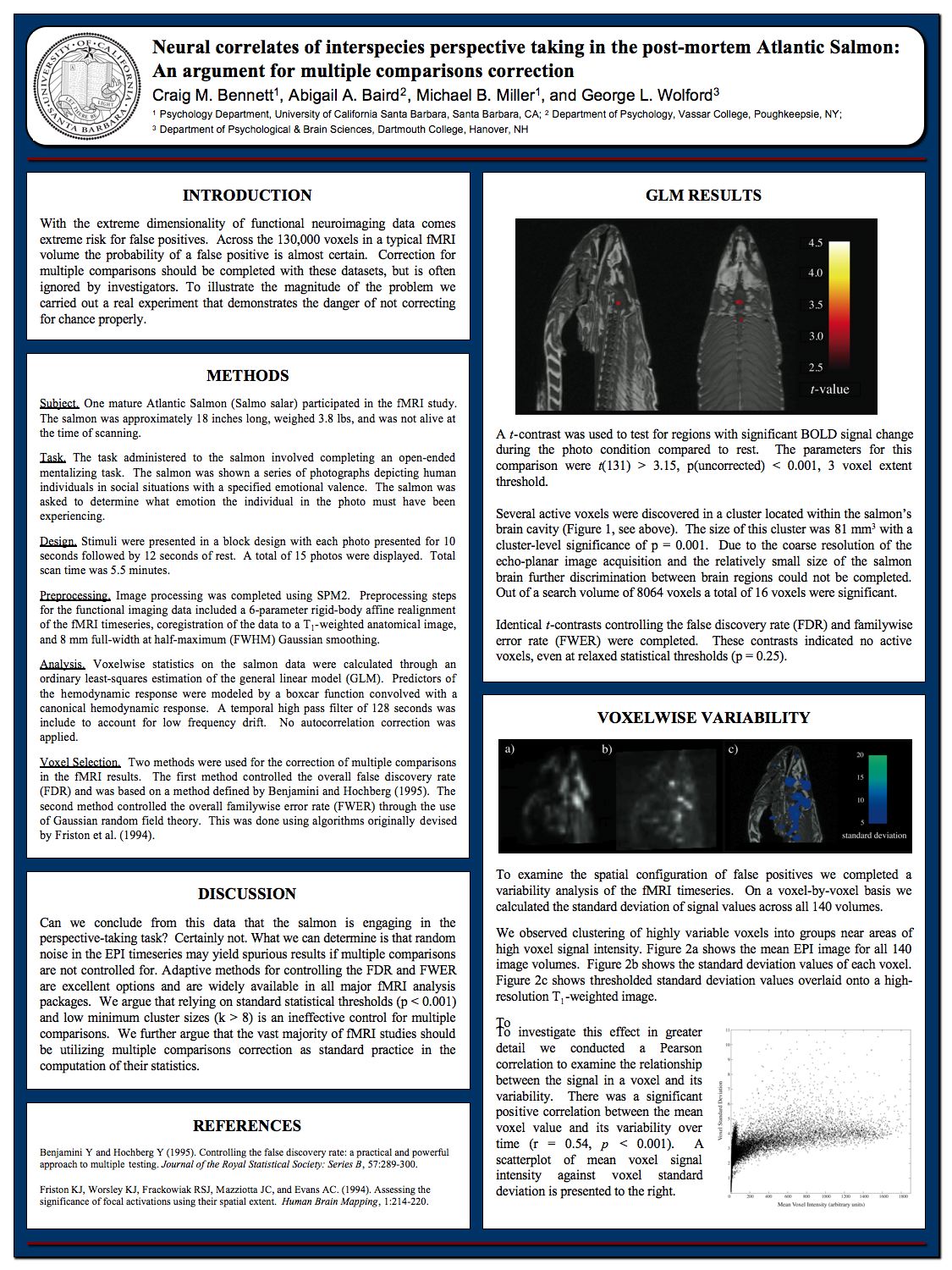
Neural correlates of interspecies perspective taking in the post-mortem Atlantic Salmon: An argument for multiple comparisons correction This is a poster presented by Bennett and colleagues at this year's Human Brain Mapping conference. It's about fMRI scanning on a dead fish, specifically a salmon. They put the salmon in an MRI scanner and "the salmon was shown a series of photographs depicting human individuals in social situations. The salmon was asked to determine what emotion the individual in the photo must have been experiencing."
I'd say that this research was justified on comedic grounds alone, but they were also making an important scientific point. The (fish-)bone of contention here is multiple comparisons correction. The "multiple comparisons problem" is simply the fact that if you do a lot of different statistical tests, some of them will, just by chance, give interesting results.
In fMRI, the problem is particularly severe. An MRI scan divides the brain up into cubic units called voxels. There are over 40,000 in a typical scan. Most fMRI analysis treats every voxel independently, and tests to see if each voxel is "activated" by a certain stimulus or task. So that's at least 40,000 separate comparisons going on - potentially many more, depending upon the details of the experiment.
Luckily, during the 1990s, fMRI pioneers developed techniques for dealing with the problem: multiple comparisons correction. The most popular method uses Gaussian Random Field Theory to calculate the probability of falsely "finding" activated areas just by chance, and to keep this acceptably low (details), although there are other alternatives.
But not everyone uses multiple comparisons correction. This is where the fish comes in - Bennett et al show that if you don't use it, you can find "neural activation" even in the tiny brain of dead fish. Of course, with the appropriate correction, you don't. There's nothing original about this, except the colourful nature of the example - but many fMRI publications still report "uncorrected" results (here's just the last one I read).
Bennett concludes that "the vast majority of fMRI studies should be utilizing multiple comparisons correction as standard practice". But he says on his blog that he's encountered some difficulty getting the results published as a paper, because not everyone agrees. Some say that multiple comparisons correction is too conservative, and could lead to genuine activations being overlooked - throwing the baby salmon out with the bathwater, as it were. This is a legitimate point, but as Bennett says, in this case we should report both corrected and uncorrected results, to make it clear to the readers what is going on.
Posted in
bad neuroscience,
fMRI,
funny,
science,
voodoo
Psych Drug Acronyms Explained!
14.00
wsn
Modern psychiatry is an alphabet soup of acronyms. Sometimes it seems like there are almost as many as there are drugs. This can be confusing. So, here's a quick guide to what they really mean.
Please add any of your own in the comments!
SSRI - Sexual Stimulation Required Increased(*)Disclaimer - The digs at SSRIs are probably unfair: in my experience, the withdrawal symptoms are mild and I think the claimed link to suicide is most likely a myth. But it's funny.
Also, Suicides? Suppress Report Immediately!(*)
Also, Stopped Suddenly - Regret Imminent?(*)
NRI - No Real Impact?(*)
Also, Nix Relevant Information(*)
NASSA (mirtazapine) - Never Again Slim; Sleep Alot.(*)
Also, Nighttime, And Strange Sights Abound(*)
TCA - The Classic Antidepressants(*)
Also, Toxicity - Cardiac Arrests(*)
ECT - Effective, Cheap Treatment(*)
Also Erases Childhood Thoughts?(*)
VNS - Very Nebulous Science(*)
Also, Very New Snakeoil?
fMRI - Future Marketable Research Initiative(*)
Posted in
antidepressants,
drugs,
funny,
mental health
The Onion Does China
10.23
wsn
The Onion turns its satirical eye on China, with hilarious if not entirely PC results -
Here's a screenshot for posterity, because their "special issues" tend to go back to normal pretty quickly. I always think it's a little odd that the Chinese government don't have anyone whose default assumption is that they're in the right. Whenever a Western or a Western-aligned country does something morally... questionable, you can count on conservatives to defend it. Whereas countries with a history of Western exploitation generally enjoy the benefit of the liberal doubt. But China, almost uniquely, gets it from left, right, and centre equally.
I remember a colleague's astonishment when a Chinese post-doc expressed the opinion that Tibet was part of China and should remain so. This was an idea that she'd just never heard before, and she clearly thought it was entirely bizarre. Yet it was only 40 years ago that many French people were of the opinion that L’Algérie est française et le restera - Algeria! And there are still people in Northern Ireland who might kill you if you suggest that that province doesn't belong to Britain.
Posted in
controversiology,
funny,
politics
The Spooky Case of the Disappearing Crap Science Article
07.00
wsn
Just a few hours ago, I drafted a post about a crap science study in the Daily Telegraph called "Stress of modern life cuts attention spans to five minutes".
The pressures of modern life are affecting our ability to focus on the task in hand, with work stress cited as the major distraction, it said.Almost identical stories appeared in the Daily Mail (no surprise) and, for some reason, an awful lot of Indian news sites. So I hacked out a few curmudgeonly lines - but before I posted them, the story had vanished! (Update: It's back! See end of post). Spooky. But first, the curmudgeonry:
Declining attention spans are causing household accidents such as pans being left to boil over on the hob, baths allowed to overflow, and freezer doors left open, the survey suggests.
A quarter of people polled said they regularly forget the names of close friends or relatives, and seven per cent even admitted to momentarily forgetting their own birthdays.
The study by Lloyds TSB insurance showed that the average attention span had fallen to just 5 minutes, down from 12 minutes 10 years ago.
But the over-50s are able to concentrate for longer periods than young people, suggesting that busy lifestyles and intrusive modern technology rather than old age are to blame for our mental decline.
"More than ever, research is highlighting a trend in reduced attention and concentration spans, and as our experiment suggests, the younger generation appear to be the worst afflicted," said sociologist David Moxon, who led the survey of 1,000 people.
- Crap science story in "crap" shocker
 The term "attention span" is meaningless - attention to what? Are we so stressed out that after five minutes down the pub, we tend to forget our pints and wander home in a daze? You could talk about attention span for a particular activity, so long as you defined your criteria for losing attention - for example, you could measure the average time a student sits in a lecture before he starts doodling on his notes. Then if you wanted you could find out if stress affects that time. I wouldn't recommend it, because it would be very boring, but it would be a scientific study.
This news, however is not based on a study of this kind. It's based on a survey of 1,000 people i.e. they asked people how long their attention span was and whether they felt they were prone to accidents. No doubt the questions were chosen in such a way that they got the answers they wanted. Who are "they"? - Lloyds TSB insurance, or rather, their PR department, who decided that they would pay Mr David Moxon MSc. to get them the results they wanted. He obliged, because that's what he does. Then the PR people wrote up Moxon's "results" as a press release and sent it out to all the newspapers, where stressed-out, over-worked journalists (there's a grain of truth to every story!) leapt at the chance to fill some precious column inches with no thinking required. Lloyds get their name in the newspapers, their PR company gets cash, and Moxon gets cash and his name in the papers so he gets more clients in the future. Sorted!
How do I know this? Well, mainly because I've read Ben Goldacre's Bad Science and Nick Davie's Flat Earth News, two excellent books which explain in great detail how modern journalism works and how this kind of PR junk routinely ends up on the pages of your newspapers in the guise of science or "surveys". However, even if I hadn't, I could have worked it out by just consulting Google regarding Mr Moxon. Here is his website. Here's what Moxon says about his services:
David can provide a wide range of traditional behavioural research methods on a diverse range of social, psychological and health topics. David works in partnership with clients delivering precisely the brief they require whilst maintaining academic integrity.
The more commonly provided services include:In other words, he gets the results you want. And he urges potential customers to
The development and compilation of questionnaire or survey questions
Statistical analysis of data (including SPSS® if required)
The development of personality typologies
The production of media friendly tests and quizzes (always with scoring systems)
The production of primary research reports identifying ‘top line findings’ as well as providing detailed results and conclusions.
Contact the consultancy which gives you fast, highly-creative and psychologically-endorsed stories that grab the headlines.
- The Disappearance
So, what happened? Did both the Mail and the Telegraph suddenly experience an severe attack of journalistic integrity and decide that this story was so bad, they weren't even going to host it on their websites? It seems doubtful, especially in the case of the Mail, but it's possible.
I prefer a different explanation: my intention to rubbish the story travelled forwards in time, and caused the story to be taken down, even though I hadn't posted about it yet. Lynn McTaggart has proven that this can happen, you know.
Update 27th November 13:30: And it's back! The story has reappeared on the Telegraph website. The Lay Scientist tells me that the story was originally put up too prematurely and then pulled because it was embargoed until today. I don't quite see why it matters when a non-story like this is published - it could just as well have been 10 years ago - but there you go. And in a ridiculous coda to this sorry tale, the Telegraph have today run a second crap science article centered around the concept of "5 minutes" - according to the makers of cold and flu remedy Lemsip, 52% of women feel sorry for their boyfriends when they're ill for just five minutes or less. Presumably because this is their attention span. How I wish I were making this up.
Posted in
bad neuroscience,
funny,
media,
woo