You're (Brain Is) So Immature

How mature are you? Have you ever wanted to find out, with a 5 minute brain scan? Of course you have. And now you can, thanks to a new Science paper, Prediction of Individual Brain Maturity Using fMRI.

This is another clever application of the support vector machine (SVM) method, which I've written about previously, most recently regarding "the brain scan to diagnose autism". An SVM is a machine learning algorithm: give it a bunch of data, and it'll find patterns in it.

In this case, the input data was brain scans from children, teenagers and adults, and the corresponding ages of each brain. The pattern the SVM was asked to find was the relationship between age and some complex set of parameters about the brain.

The scan was resting state functional connectivity fMRI. This measures the degree to which different areas of the brain tend to activate or deactivate together while you're just lying there (hence "resting"). A high connectivity between two regions means that they're probably "talking to each other", although not necessarily directly.

It worked fairly well:

Out of 238 people aged 7 to 30, the SVM was able to "predict" age pretty nicely on the basis of the resting state scan. This graph shows chronological age against predicted brain age (or "fcMI" as they call it). The correlation is strong: r2=0.55.

The authors then tested it on two other large datasets: one was resting state, but conducted on a less powerful scanner (1.5T vs 3.0T) (n=195), and the other was not designed as a resting state scan at all, but did happen to include some resting state-like data (n=186). Despite the fact that these data were, therefore, very different to the original dataset, the SVM was able to predict age with r2 over 0.5 as well.

*

What use would this be? Well, good question. It would be all too easy to, say, find a scan of your colleague's brain, run it through the Mature-O-Meter, and announce with glee that they have a neurological age of 12, which explains a lot. For example.

However, while this would be funny, it wouldn't necessarily tell you anything about them. We already know everyone's neurological age. It's... their age. Your brain is an old as you are. These data raise the interesting possibility that people with a higher Maturity Index, for their age, are actually more "mature" people, whatever that means. But that might not be true at all. We'll have to wait and see.

How does this help us to understand the brain? An SVM is an incredibly powerful mathematical tool for detecting non-linear correlations in complex data. But just running an SVM on some data doesn't mean we've learned anything: only the SVM has. It's a machine learning algorithm, that's what it does. There's a risk that we'll get "science without understanding" as I've written a while back.

In fact the authors did make a start on this and the results were pretty neat. They found that as the brain matures, long-range functional connections within the brain become stronger, but short-range interactions between neighbours get weaker and this local disconnection with age is the most reliable change.

You can see this on the pic above: long connections get stronger (orange) while short ones get weaker (green), in general. This is true all across the brain.

It's like how when you're a kid, you play with the kids next door, but when you grow up you spend all your time on the internet talking to people thousands of miles away, and never speak to your neighbours. Kind of.

Link: Also blogged about here.

ResearchBlogging.orgDosenbach NU, Nardos B, Cohen AL, Fair DA, Power JD, Church JA, Nelson SM, Wig GS, Vogel AC, Lessov-Schlaggar CN, Barnes KA, Dubis JW, Feczko E, Coalson RS, Pruett JR Jr, Barch DM, Petersen SE, & Schlaggar BL (2010). Prediction of individual brain maturity using fMRI. Science (New York, N.Y.), 329 (5997), 1358-61 PMID: 20829489

"Koran Burning"

According to the BBC:

Koran protests sweep Afghanistan... Thousands of protesters have taken to the streets across Afghanistan... Three people were shot when a protest near a Nato base in the north-east of the country turned violent.
Wow. That's a lot of fuss about, literally, nothing - the Koran burning hasn't happened. So what are they angry about? The "Koran Burning" - the mere idea of it. That has happened, of course - it's been all over the news.

Why? Well, obviously, it's a big deal. People are getting shot protesting about it in Afghanistan. It's news, so of course the media want to talk about it. But all they're talking about is themselves: the news is that everyone is talking about the news which is that everyone is talking about...

A week ago no-one had heard of Pastor Jones. The only way he could become newsworthy is if he did something important. But what he was proposing to do was not, in itself, important: he was going to burn a Koran in front of a handful of like-minded people.

No-one would have cared about that, because the only people who'd have known about it would have been the participants. Muslims wouldn't have cared, because they would never have heard about it. "Someone You've Never Heard Of Does Something" - not much of a headline.

But as soon as it became news, it was news. Once he'd appeared on CNN, say, every other news outlet was naturally going to cover the story because by then people did care. If something's on CNN, it's news, by definition. Clever, eh?


What's odd is that Jones actually announced his plans way back in July; no-one took much notice at the time. Google Trends shows that interest began to build only in late August, peaking on August 22nd, but then falling off almost to zero.

What triggered the first peak? It seems to have been the decision of the local fire department to deny a permit for the holy book bonfire, on August 18th. (There were just 6 English-language news hits between the 1st and the 17th.)

It all kicked off when the Associated Press reported about the fire department's decision on August 18th and was quickly followed up by everyone else; the AP credit the story to the local paper The Gainsville Sun who covered the story on the same day.

But in their original article, the Sun wrote that Pastor Jones had already made "international headlines" over the event. Indeed there were a number of articles about it in late July following Jones's original Facebook announcement. But interest then disappeared - there was virtually nothing about it in the first half of August, remember.

So there was, it seems, nothing inevitable about this story going global. It had a chance to become a big deal in late July - and it didn't. It had another shot in mid-August, and it got a bit of press that time, but then it all petered out.

Only this week has the story become massive. US commander in Afghanistan General Petraeus spoke out on September 6th; ironically, just before the story finally exploded, since as you can see on the Google Trends above, searches were basically zero up until September 7th when they went through the roof.

So the "Koran Burning" story had three chances to become front-page global news and it only succeeded on the third try. Why? The easy answer is that it's an immediate issue now, because the burning is planned for 11th September - tomorrow. But I wonder if that's one of those post hoc explanations that makes whatever random stuff that happened seem inevitable in retrospect.

The whole story is newsworthy only because it's news, remember. The more attention it gets, the more it attracts. Presumably, therefore, there's a certain critical mass, the famous Tipping Point, after which it's unstoppable. This happened around September 6th, and not in late July or mid August.

But there's a random factor: every given news outlet who might run the story, might decide not to; maybe it doesn't have space because something more important happened, or because the Religion correspondent was off sick that day, etc. Whether a story reaches the critical mass is down to luck, in other words.

The decision of a single journalist on the 5th or the 6th might well have been what finally tipped it.

Autistic Toddlers Like Screensavers

Young children with autism prefer looking at geometric patterns over looking at other people. At least, some of them do. That's according to a new study - Preference for Geometric Patterns Early in Life As a Risk Factor for Autism.

Pierce et al took 110 toddlers (age 14 to 42 months). Some of them had autism, some had "developmental delay" but not autism, and some were normally developing.

The kids were shown a one-minute video clip. One half of the screen showed some kids doing yoga, while the other was a set of ever-changing complex patterns. A bit like a screensaver or a kaleidoscope. Eye-tracking apparatus was used to determine which side of the screen each child was looking at.

What happened? Both the healthy control children, and the developmentally delayed children, showed a strong preference for the "social" stimuli - the yoga kids. However, the toddlers with an autism spectrum disorder showed a much wider range of preferences. 40% of them preferred the geometric patterns. Age wasn't a factor.

This makes intuitive sense because one of the classic features of autism is a fascination with moving shapes such as wheels, fans, and so on. The authors conclude that

A preference for geometric patterns early in life may be a novel and easily detectable early signature of infants and toddlers at risk for autism.
But only a minority of the autism group showed this preference, remember. As you can see from the plot above, they spanned the whole range - and over half behaved entirely normally.

There was no difference between the "social" and "geometrical" halves of the autism group on measures of autism symptoms or IQ, so it wasn't just that only "more severe" autism was associated with an abnormal preference.

They re-tested many of the kids a couple of weeks later, and found a strong correlation between their preference on both occasions, suggesting that it is a real fondness for one over the other - rather than just random eye-wandering.

So this is an interesting result, but it's not clear that it would be of much use for diagnosis.

ResearchBlogging.orgPierce K, Conant D, Hazin R, Stoner R, & Desmond J (2010). Preference for Geometric Patterns Early in Life As a Risk Factor for Autism. Archives of general psychiatry PMID: 20819977

The Horror, The Horror

You're watching a horror movie.

The characters are going about their lives, blissfully unaware that something horrifying is about to happen. You the viewer know that things are going to end badly, though, because you know it's a horror movie.

Someone opens a closet - a bloody corpse could fall out! Or they're drinking a glass of water - which could be infected with a virus! Or they're talking to some guy - who's probably a serial killer! And so on.

The effect of this - and a good director can get a lot of mileage from it - is that scenes which would otherwise be entirely mundane, are experienced as scary, purely because you know that something scary is going to happen, so you see potential horror in every innocent little thing. An expectation as to what's going to happen, leads to you interpreting events in a certain way, and this creates certain emotions.

In a medical context, that would be called a placebo effect. Or a nocebo effect when expectations make people feel worse rather than better.


The horror movie analogy is useful, because it shows that placebo effects don't just happen to other people. We all like to think that if we were given a placebo treatment, we wouldn't be fooled. Unlike all those silly, suggestible, placebo responders, we'd stay as sick as ever until we got a proper cure.

I wouldn't be so sure. We're always interpreting the world around us, and interpreting our own thoughts and feelings, on the basis of our expectations and beliefs about what's going on. We don't suddenly stop doing this when it comes to health.

Suppose you have the flu. You feel terrible, and you're out of aspirin. You don't think you'll be able to make that meeting this afternoon, so you phone in sick.

Now, clearly, flu is a real disease, and it really does make you feel ill. But how do you know that you wouldn't be able to handle the meeting? Unless you have an extensive history of getting the flu in all its various forms, this is an interpretation, a best guess as to what you'll feel in the future, and it might be too pessimistic.

Maybe, if you tried, you'd get on OK. Maybe if you had some aspirin that would reassure you enough to give it a go. And just maybe it would still have worked even if those "aspirins" were just sugar pills...

Link: See my previous posts I Feel X, Therefore Y and How Blind is Double Blind?

Normal? You're Weird - Psychiatrists

Almost everyone is pretty screwed up. That's not my opinion, that's official - according to a new paper in the latest British Journal of Psychiatry.

Make sure you're sitting down for this. No less than 48% of the population have "personality difficulties", and on top of that 21% have a full blown "personality disorder", and another 7% have it even worse with "complex" or "severe" personality disorders.

That's quite a lot of people. Indeed it only leaves an elite 22.5% with no personality disturbances whatsoever. You're as likely to have a "simple PD" as you are to have a normal personality, and fully half the population fall into the "difficulties" category.

I have difficulties with this.

Where do these results come from? The Adult Psychiatric Morbidity Survey, which is a government study of the British population. They phoned up a random sample of several thousand people, and gave them the SCID interview, in other words they asked them questions. 116 questions in fact.

48% of people answered "yes" to enough questions such that, according to their criteria, they had "personality difficulties". They defined "personality difficulties", which is not a term in common use, as being "one criterion less than the threshold for personality disorder (PD)" according to DSM-IV criteria.

So what? Well, as far as I'm concerned, that means simply that "personality difficulties" is a crap category, which labels normality as pathological. I can tell that most of people with "difficulties" are in fact normal because they are the literally the norm. It's not rocket science.

So we can conclude that "personality difficulties" should either be scrapped or renamed "normal". In which case the weird minority of people without any such features should be relabelled. Maybe they are best known as "saints", or "Übermenschen", or perhaps "people who lie on questionnaires".

This, however, is not what the authors say. They defend their category of Personality Difficulties on the grounds that this group are slightly more likely to have a history of "issues" than the elite 22.5 percent, e.g. homelessness (3.0% vs. 1.6%), 'financial crisis' (10.1% vs. 6.8%), or having had treatment for mental illness (11% vs 6%).

They say:

The finding that 72% of the population has at least some degree of personality disturbance is counterintuitive, but the evidence that those with ‘personality difficulty’ covering two out of five of the population [it's actually closer to half], differs significantly from those with no personality disturbance in the prevalence of a history of running away from home, police contacts, homelessness... shows that this separation is useful from both clinical and societal viewpoints.
Well, yeah...but no. The vast majority (90+%) of people with Personality Difficulty had no history of these things. It's true that, as a group, they have higher average rates, but all this tells you is that some of them have problems. I suspect they're the ones right at the "top end" of this category, the people who are almost into the next category up.

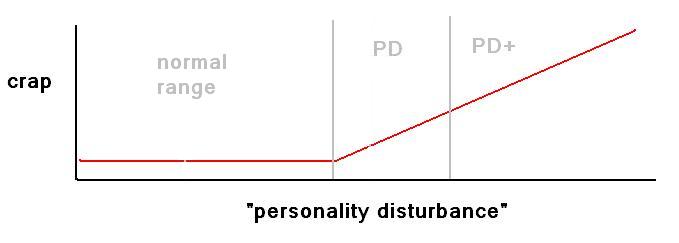
Here's what I think is going on:

The "difficulties" group and the "none" group are essentially the same in terms of the levels of crap stuff happening to them - because they are the same, normal, everyday people - except that a small % of the "difficulties" group do have some moderate degree of problems, because they are close to being "PD".

This does not mean that the "difficulties" category is good. Quite the reverse, it means it's rubbish, because it spans so many diverse people and lumps them all together. What you should do, if you insist on drawing lines in the sand, would be this:

Now I don't know that that's how things work, but it seems plausible. Bearing in mind that the categories they used are entirely arbitrary, it would be very odd if they did correspond to reality.

To be fair to the authors, this is not the only argument in their paper. Their basic point is that personality disturbance is a spectrum: rather than it being a black-and-white question of "normal" vs."PD", there are degrees, ranging from "simple PD" which is associated with a moderate degree of life crap, up to "complex PD" which has much more and "severe PD" which is worst of all.

They suggest that in the upcoming DSM-V revision of psychiatric diagnosis, it would be useful to formally incorporate the severity spectrum in some way - unlike the current DSM-IV, there everything is either/or. They also argue that with more severe cases of PD, it is not very useful to assign individual PD diagnoses (DSM-IV has no less than 10 different PDs) - severe PD is just severe PD.

That's all fine, as long as it doesn't lead to pathologizing 78% of the population - but this is exactly what it might do. The authors do admit that "the SCID screen for personality disorder, like almost all screening instruments, overdiagnoses personality pathology", but provide little assurance that a "spectrum" approach won't do the same thing.

ResearchBlogging.orgYang M, Coid J, & Tyrer P (2010). Personality pathology recorded by severity: national survey. The British Journal of Psychiatry 197, 193-9 PMID: 20807963

Are "Antipsychotics" Antipsychotics?

This is the question asked by Tilman Steinert & Martin Jandl in a letter to the journal Psychopharmacology.

They point out that in the past 20 years, the word "antipsychotic" has exploded in popularity. Less than 100 academic papers were published with that word in the title in 1990, but now it's over 600 per year.

The older term for the same drugs was "neuroleptics". This terminology, however, has slowly but surely fallen into disuse over the same time period.

To illustrate this they have a nice graph of PubMed hits. Neuroskeptic readers will be familiar with these as I have often posted my own and I recently wrote a bash script to harvest this data automatically. Now you too can be a historian of medicine from the comfort of your own home...

Why does it matter what we call them? A name is just a name, right? No, that's the problem. Actually, neuroleptic is just a name, because it doesn't mean anything. The term derives from the Greek "neuron", meaning... neuron, and "lambanō" meaning "to take hold of". However, no-one knows that unless they look it up on Wikipedia because it's just a name.

Antipsychotic, on the other hand, means something: it means they treat psychosis. But whether or not this is an accurate description of what "antipsychotics" actually do, is controversial. For one thing, these drugs are also used to treat many non-psychotic illnesses, like depression, and PTSD.

More fundamentally, it's not universally accepted that they have a direct anti-psychotic effect. All antipsychotics are powerful sedatives. There's a school of thought that says that this is in fact all they are, and rather than treating psychosis, they just sedate people until they stop being obviously psychotic.

Personally, I don't believe that, but that's not really the point: the point is that it's controversial, and calling them antipsychotics makes it hard to think about that controversy in a sensible way. To say that antipsychotics aren't actually antipsychotic is a contradiction in terms. To say they are antipsychotic is a tautology. Names shouldn't dictate the terms of a debate in that way. A name should just be a name.

The same point applies to more than just antipsychotics - I mean neuroleptics - of course. Perhaps the worst example is "antidepressants". Prozac, for example, is called an antidepressant. Implying that it treats depression.

But according to clinical trials, Prozac and other SSRIs are a lot more effective, relative to placebo, in obsessive-compulsive disorders (OCD) than they are in depression (though this is not necessarily true of all "antidepressants", yet more evidence that the word is unhelpful.)

So, as I asked in a previous post: "Are SSRIs actually antiobsessives that happen to be helpful in some cases of depression?" Personally, I think the only name for them which doesn't make any questionable assumptions, is simply 'SSRIs'.

ResearchBlogging.orgTilman Steinert and Martin Jandl (2010). Are antipsychotics antipsychotics? Psychopharmacology DOI: 10.1007/s00213-010-1927-3

Marc Hauser's Scapegoat?

The dust is starting to settle after the Hauser-gate scandal which rocked psychology a couple of weeks back.

Harvard Professor Marc Hauser has been investigated by a faculty committee and the verdict was released on the 20th August: Hauser was "found solely responsible... for eight instances of scientific misconduct." He's taking a year's "leave", his future uncertain.

Unfortunately, there has been no official news on what exactly the misconduct was, and how much of Hauser's work is suspect. According to Harvard, only three publications were affected: a 2002 paper in Cognition, which has been retracted; a 2007 paper which has been "corrected" (see below), and another 2007 Science paper, which is still under discussion.

But what happened? Cognition editor Gerry Altmann writes that he was given access to some of the Harvard internal investigation. He concludes that Hauser simply invented some of the crucial data in the retracted 2002 paper.

Essentially, some monkeys were supposed to have been tested on two conditions, X and Y, and their responses were videotaped. The difference in the monkey's behaviour between the two conditions was the scientifically interesting outcome.

In fact, the videos of the experiment showed them being tested only on condition X. There was no video evidence that condition Y was even tested. The "data" from condition Y, and by extension the differences, were, apparently, simply made up.

If this is true, it is, in Altmann's words, "the worst form of academic misconduct." As he says, it's not quite a smoking gun: maybe tapes of Y did exist, but they got lost somehow. However, this seems implausible. If so, Hauser would presumably have told Harvard so in his defence. Yet they found him guilty - and Hauser retracted the paper.

So it seems that either Hauser never tested the monkeys on condition B at all, and just made up the data, or he did test them, saw that they weren't behaving the "right" way, deleted the videos... and just made up the data. Either way it's fraud.

Was this a one-off? The Cognition paper is the only one that's been retracted. But another 2007 paper was "replicated", with Hauser & a colleague recently writing:

In the original [2007] study by Hauser et al., we reported videotaped experiments on action perception with free ranging rhesus macaques living on the island of Cayo Santiago, Puerto Rico. It has been discovered that the video records and field notes collected by the researcher who performed the experiments (D. Glynn) are incomplete for two of the conditions.
Luckily, Hauser said, when he and a colleague went back to Puerto Rico and repeated the experiment, they found "the exact same pattern of results" as originally reported. Phew.

This note, however, was sent to the journal in July, several weeks before the scandal broke - back when Hauser's reputation was intact. Was this an attempt by Hauser to pin the blame on someone else - David Glynn, who worked as a research assistant in Hauser's lab for three years, and has since left academia?

As I wrote in my previous post:
Glynn was not an author on the only paper which has actually been retracted [the Cognition 2002 paper that Altmann refers to]... according to his resume, he didn't arrive in Hauser's lab until 2005.
Glynn cannot possibly have been involved in the retracted 2002 paper. And Harvard's investigation concluded that Hauser was "solely responsible", remember. So we're to believe that Hauser, guilty of misconduct, was himself an innocent victim of some entirely unrelated mischief in 2007 - but that it was all OK in the end, because when Hauser checked the data, it was fine.

Maybe that's what happened. I am not convinced.

Personally, if I were David Glynn, I would want to clear my name. He's left science, but still, a letter to a peer reviewed journal accuses him of having produced "incomplete video records and field notes", which is not a nice thing to say about someone.

Hmm. On August 19th, the Chronicle of Higher Education ran an article about the case, based on a leaked Harvard document. They say that "A copy of the document was provided to The Chronicle by a former research assistant in the lab who has since left psychology."

Hmm. Who could blame them for leaking it? It's worth remembering that it was a research assistant in Hauser's lab who originally blew the whistle on the whole deal, according to the Chronicle.

Apparently, what originally rang alarm bells was that Hauser appeared to be reporting monkey behaviours which had never happened, according to the video evidence. So at least in that case, there were videos, and it was the inconsistency between Hauser's data and the videos that drew attention. This is what makes me suspect that maybe there were videos and field notes in every case, and the "inconvenient" ones were deleted to try to hide the smoking gun. But that's just speculation.

What's clear is that science owes the whistle-blowing research assistant, whoever it is, a huge debt.

 
powered by Blogger